Author: sogolf

  • What job are customers hiring your product for?

    If you noticed I used the framework of Jobs T0 Be Done in my previous post when I tried to compare multiple email marketing solutions with each other. Asking “What job are you hiring this product for?” is an odd question and it took me some time to wrap my head around thinking about a product like it’s a person or service I can hire. This is an essence of Jobs To Be Done framework but when I talk to people not many know about it. So I researched multiple articles and listened to a couple of podcasts to learn more about it. Without further ado here is what I’ve learned:

    What is Jobs To Be Done and where does it come from?

    If you search Jobs-to-be-Done, you’ll find this video from Clay Christensen, a famous Harvard Business School professor who came up with the framework. (He’s also the guy who came up with the idea of Disruptive Innovation in his seminal book the The Innovator’s Dilemma). Anyway, Clay speaks about a product development issue in a fast food chain where they wanted to sell more milkshakes.

    Their initial approach was to talk to buyers and make changes to milkshake based on this customer analysis. They asked buyers if they like their milkshakes be healthier or more sugary, thicker or thinner etc. This failed. They sold no extra milkshakes, as there was no meaningful insight to be found in analyzing the users themselves. So he suggested that they focus on the job that customers hire a milkshake to do.

    It certainly sounds weird (no-one thinks of “hiring a milkshake”) but switching to that perspective offered new insights. After talking to buyers in this new format, it turns out more than half of the milkshakes are hired to do the job of providing sustenance and entertainment for a long commute. In this regard milkshakes were competing with bagels, bananas, and energy bars. Milkshakes had advantages over energy bars and bananas, as they’re tidier and easier to consume in a car. They beats bagels because bagels are too dry and leave you thirsty in your car. They beats coffee because they are more filling and less likely to don’t leave you desperate for a bathroom in the midst of a 40 minute drive. Once the chain realized this, they were able to make changes that made milkshakes the best tool for the job.

    When using Personas are helpful

    Similar to the restaurant chain example above product designer, product manager and UX/UI  team try to talk to users to understand what they’re looking to get out of  software. They come up with user personas and user roles.  Once personas are defined, then they try to design and define a system in a way to deliver users’ needs and wants as a series of user stories.

    Personas work well when the user base is broken down into different types of users with different needs. For example, if trying to create a market place it is helpful to define distinctive types of personas based on buyers and sellers roles. These personas are definitely helpful to define what your system must fulfill for each of them.

    When Personas are not useful, focus on the Job instead

    However for many products (and I’m thinking many B2C type of software) the customers come in all shapes and sizes, from all countries, all backgrounds, all salaries, all levels of computer skills. In these circumstances defining persona is not as useful as there is no way to group your users into meaningful roles to define a system for.

    Another time when focusing on the job is more helpful is when a situation dictates the solution as oppose to your user’s characteristics or attribute.

    For example, after a long day of work and with an empty fridge, Alan who is single and in his early 30s is looking for a comfort food with minimal prep time and dish washing afterwards. That when he orders Pizza! However the same Alan on Friday night when he has a date  in order to impress his date, he’ll go to a fancy Italian restaurant.

    In both cases the situation and the problem context dictated the solution as oppose to Allan’s attributes of being ‘single’ or ‘in his 30s’.

    Jobs-To-Be-Done framework becomes very useful because the product is better defined by the job they do than the personas it serves. Now it’s best to get an intimate understanding of the job itself, what creates demand for it, and what ultimately what you’d hire to do the job.

    Another cool example that I’m going to borrow from Intercom blog is when you hire a photo app:

    When do you hire a web app?

    There are a few different jobs you might like to do once you’ve taken a photograph. Here’s six:

    1. Capture this moment privately for me and her, so we can (hopefully) look back on it fondly in years to come
    2. Embarrass my friend in front of her friends, cause she’ll regret this in the morning.
    3. Get this file backed up online, so I can point others to it.
    4. Get a copy of this photo to my grandmother who doesn’t use computers.
    5. Make this look cool and interesting. Like me. And then share it.
    6. Get this edited and into my portfolio so that people consider hiring me for future engagements.

    In this case the products you could hire are Facebook, Flickr, iPhoto, Instagram, maybe 500px. When you think about how many of these apps you use, you realize that the job is the distinction here, not you. You haven’t changed.

    Jobs-To-Be-Done Interview and Job Stories

    To understand “the job” you have to interview users to understand their struggles, alternative solutions to the job and finally what made them purchase your product to solve the job. (There is a Jobs-To-Be-Done interview course  teaching interview techniques). As a product manager you act as a detector! your mission is to find out:

    • what situation the users were in when they encountered the job?
    • what caused them to take the action ?
    • What steps they took to come to the conclusion to hire your products?
    • What are other solutions (software or not) that are competing with the solution you offer?

    For the reasons outlined above, Alan Klement goes as far as suggestion to use Job Stories instead of User Stories.

    There is so much for to learn about this framework and I find it fascinating. One final thing I learned is that there are no new jobs! Jobs don’t change but the solution that’s satisfy the job changes over time. What do you think?

    Resources

    Finally if you are interested to learn more about this let me know, I know a great knowledgeable person  in GTA and we have a meetup to chat JTBD if there is enough interests 🙂
  • email marketing comparison: MailChimp vs AWeber vs GetResponse

    My friend is building a startup on helping teachers and schools to grow edible garden and I’m tasked to choose the right email marketing software for her. I am  beginner at “Job To be Done” framework but I think it’s a worthwhile exercise to look at these SaaS services I want to hire for the following “Jobs”:

    1. When moving lists of prospects (educators in our case) to another provider I want to do its as seamlessly as possible so I can communicate with my new list without additional hassles such as opt-in
    2. When delivering a series of emails in a span of couple of days I want to use automation (aka Autoresponder or drip emails) so I can send emails in a specific time frame with out the need to set it up manually.
    3.  When launching my products with help of my partners I want to use Affiliate link so I can track number of users from my partner’s list who bought my product and to pay a commission to my affiliates
    4. When creating landing pages for my list I want to integrate with external tools that build landing pages (such as Lead Pages, Optimize Press etc) so I can create a solution for capturing email addresses and provide information about my product without a need to code.
    5. Finally monthly price of the SaaS is another important factor in my comparison

    We currently have our lists hosted in MailChimp and we’re considering other providers:

    Note 1: In this comparison I really wanted to consider ConvertKit (given that I’m a Nathan’s fan and heard good thing about the product) but they didn’t offer any type of trial account to even dabble with. What a bummer 🙁 No matter how good you say your product is, if I can’t test it myself I wont use this.

    Note 2: I had a hard time differentiating between an Affiliate links vs Affiliate Program. In my mind the first one is a link with special id embedded in URL to track all the potential buys coming through a partner on your landing page. The second one is Affiliate Program is the similar concept only that you’re the partner sending traffic to the email marketing provider.

    Anyway lets jump in:

    Mail ChimpAweberGet Response Convert Kit
    Trial Versionyes – Everyone can stay with a ‘Free’ plan until they hit 2,000+ subscribers. Has limited feature-setyes- 30 day full version trialyes- 30 day full version trialNo- booo!
    Drip emailyes- But can’t test until I have paid account 🙁yes- it’s a bit complicatedyes- it seems relatively straight forwardyes- but I can’t test it
    Affiliate LinksMonkey Rewards (which deducts $$ from your monthly fee)
    Allows embedding affiliate links in emails
    30% commission through partner program
    Allows embedding affiliate links in emails
    pays 33% commission through partner program
    Allows embedding affiliate links in emails
    Pays 30% ongoing commission through partner program
    integration with Landing Pages (LeadPages specifically)yesyesyesno?
    Other featuresLots and lots of template for landing pages in addition to email templates
    Monthly PriceFREE for 0-2,000 users
    $30-$150 for 2,000 to 20,000 (roughly $5/m increase per 500 users)
    $19 for 0-500 users
    $29 for 500-2,500
    $49 for 2,500-5,000
    $69 for 5,000-10,000
    $15 for 0-1000 users
    $49 for 1,000-5,000
    $165 for 5,000-10,000
    $29 for 0-1,000 users
    $49 for 1,000-3,000
    $79 for 3,000-5,000
    $119 for 5,000-10,000

     Honestly for me MailChimp comes as the winner with GetResponse being the runner up. Any feedback you have that help us is greatly appreciated 🙂

  • A neat technique to manage product requirements

    I came across this awesome video from Ryan Singer via Mind the Product blog and I just couldn’t pass up the opportunity to share it. It’s a neat method to categories a million items that comes up during product development. It talks about identifying and decoupling ‘orthogonal’ tasks. This means you find tasks that are independent of each other (doing or not doing task  A doesn’t have a prevent you for doing task B) put them in separate bucket/category. If use find another task (say task C) needs to be done after task A then A and C belong to one bucket. By the end of  this exercise you have a couple of different buckets (look at the image below) that are all independent of each other. Within each bucket though there are a sequence of tasks that are related together. The great think about this technique is that it helps you, as a Product Manager to be able to focus on the most important bucket on at a time and delegate another bucket to another group.

    I loved how simple, short but super powerful this can be! Enjoy:


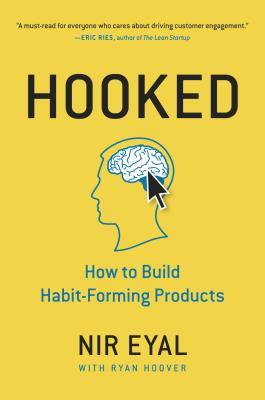
  • Hooked: A Book Review

    What the Hooked book is about?

    hooked a habit forming product book reviewI recently finished reading Hooked: How to Build Habit Forming Products and wanted to share what I’ve learned from the book and answer the question if the book worth reading?

    The author Nir Eyal, who has an excellent blog called nirandfar.com (neat name, no?), looks into nuts and bolts of products which we spent hours of our time playing and working with. I believe he first self published the book based on his own research and posts he wrote on his blog but later the book was later got published through a publisher.

    I follow Nir’s blog also as it is focused on this topic and in I’ve learned interesting stuff (like messaging apps which I wrote about earlier).

    In my opinion this book is an extension of another excellent book Power of Habit which looks into inner mechanism of habits and how to use this mechanism to create a new behaviour or replacing an old one.

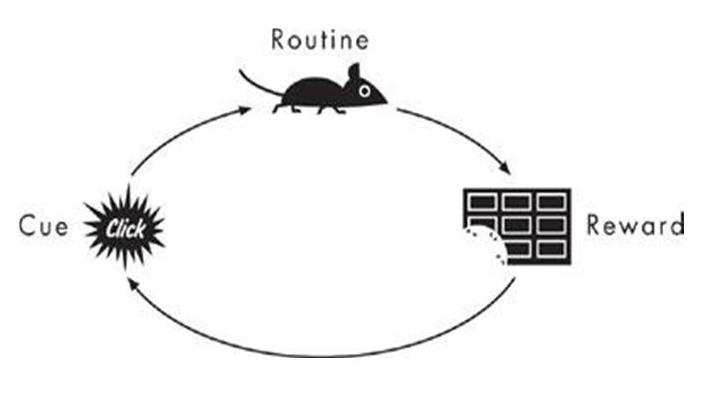
    In Power of Habit we learn that each habit or routine behaviour consists of 3 parts: 1) cue 2) routine 3) reward.

    habit-loop-charles-duhigg

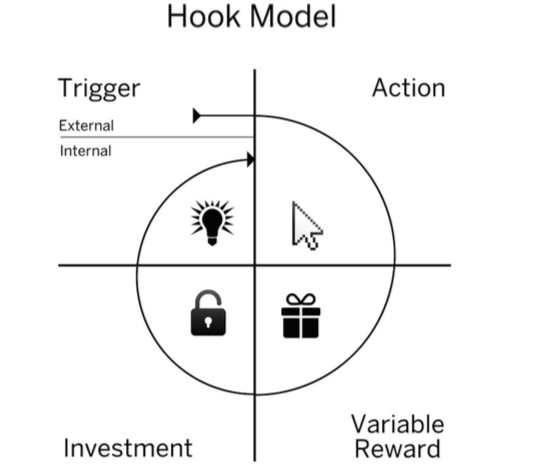
    Hooked looks at the above loop but with more detail and specifically from aspect of interacting with a product and he adds a fourth step to this loop:

    hook-model-nir-eyal

    So what are these 4 steps that we go through when we interact with sticky products?

    First one is trigger: Trigger is one thing that nudge us do some thing, this can be external and explicit like a button or a link with strong call to action or internal and implicit like a fleeting feeling of boredom or the need to stay in touch with friends. This usually makes us take the next step to either click the button or open facebook page to alleviate that feeling of boredom and loneliness.

    The key thing I learned from this chapter is to underpin the internal trigger through asking “Why” from users to understand the underlying their feeling (this is heavily emphasized in Customer Development book as well). Internal trigger is most powerful because it compels users to take action without any spending marketing dollar or nudge from product designer to use the product.

    Second one is Action: the steps you take within the application or with the product in hope of achieving results, getting  feedback from. This chapter makes it clear that user takes “action” when they have enough “motivation”, “ability” to do those steps and the “trigger. (Look at the Behavioral Model by venerable BJ Fogg). Since repetition is the key step in forming a habit, the easier the action the better chance of repeating it again in future. Nir shows interesting example of how producing content on the web has evolved from challenge of hosting a website to a few clicks to create and share content in Facebook.

    Third one is Variable Reward: Not knowing what to expect for reward or having a new kind of reward is the key concept in making users repeat their actions in hope of getting more satisfaction out of that action. For example constant scrolling on Facebook, Twitter or Pinterest happens because with each scroll user doesn’t know what type of update or interesting content s/he will face therefore it keeps at scrolling again. For more info take a look at this detail blog post on the subject.

    The last step is Investment: The last phase of the Hook is where user is asked to do bit of work. This last bit of the work is what makes the user to place more value in the product. The more time spent with one product and the more personal or professional data you put in, the more user become hooked with the product. It will also be more painful to leave. Why? because we value our effort more than it’s really worth and once we become familiar with one product they keep coming back to it. I think this can explains why financial analysts keep using arcade, difficult and extremely unfriendly Bloomberg machine as oppose to better designed, easier solutions.

    What do I think about the book?

    The good:

    • I liked the book even though I was familiar with the concepts explained in the book I like detail explanation of each part of a habit as well as lots of product examples accompanied book.
    • I also liked how Nir who started out as a person not familiar with the topic in a span of 2.5 years turned the table around, did all the research, self published the book and now is considered a subject matter expert in the field.

    The bad:

    • I started this book with a lot of expectation of more in-depth material perhaps because of my own fascination with behavior change topic I didn’t find a whole lot of new things in the book. I also found the focus of example mostly on consumer products. I wish there were more B2B example or at least more variety. There was too many reference to Pinterest for my liking.
    • I also found the end of chapter exercises too high-level and actually being able to work off of it. I myself always prefer detail, practical guides over to high level blueprints.

    photo credit: I used the hook model from nirandfar.com blog and the habit loop from power of habit book page. Hope it’s ok!

  • Messaging Apps are coming

    Despite the fact that typing on mobile phone is cumbersome, messaging has been around for many years and in fact messaging is going through a surge of innovation. How come?

    There are plenty of reasons on why messaging is still in use.  The most important one is its asynchronous nature: unlike phone calls and video chats parties don’t need to be available at the same time yet conversation flows along at a decent pace. Another reason is (because typing in mobile is hard) people forgo the formalities and jump right into the main points with in a informal way and no one is surprised or offended about it. And last but not least now that our phones are with us all the time so is messaging. Through time messaging has become much more expressive.  It has evolved from sending and receiving SMS only to rich messages with pictures, stickers, videos and audio files. We can now express ourselves with more nuances in short bursts and binges through chats.

    In fact recently I’ve come across many blog posts and news article which makes me certain that messaging apps are the next big channel in reaching out to customers in a direct, casual way to start a conversation and provide services within the conversation itself.

    Products like Google Now and Siri has primed us to become more comfortable receiving help from non-human (Artificial Intelligence algorithms, bots etc). There are now many next generation messaging apps blurring the line between AI and actual human by taking on the role of  a personal coach or as a virtual assistant who get tasks done.

    Apps like Lark and Vida act as your personal health coach where you report back on what you ate, your work-out routine and other thing and your coach advise you how to stay on track to achieve your weight-loss/health goal. On the other category, Native works as your virtual travel agent who finds the best the itinerary and purchases it for you. There is Magic taking on a role of a task runner getting you errands from mundane (grocery shopping, food) to exotic (medicinal marijuna! according to this article). All you need to do is to start a conversation and ask for things/services. And there are many more.

    Finally there are weird apps like Invisible Girlfriend and Invisible Boyfriend where you fabricate an imaginary girlfriend/boyfriend in case you’re tired of being judged for being single!! It certainly wouldn’t be my way of tackling the problem but it sure is an interesting service!

    All above apps exists in addition to staggering number of messaging apps such as Facebook Messanger, WhatsApp, Line, Kik, Snapchat, Hangout etc that are all competing to capture users conversations with friends and family within their framework. All of this means one thing to me: Consolidation.

    It just makes sense to have a few messaging apps where not only you can have a rich conversation with your friends and family but also you can use them as your virtual assistant to get things done. This phenomena has happened in china where WeChat is the messaging app for millions not only to chat with each other but to interact with business to order food, arrange lifts or send and receive money.

    The biggest contender for consolidation is Messenger app (by Facebook) with well over 700+ million users and growing. This article explained the reasons on why Facebook account is no longer required for accessing Messenger. Essentially, Facebook realized not everyone wants a social network or News Feed, but everybody wants chats. Messenger is getting a boost from new features  such as send and receive money to friends, search and add GIF to keep users within Messenger and off of other competitors. And I wont be surprised if it builds or buys any assistant-as-App type of services within Messenger.

    For me part of the appeal of SMS was its access regardless of your phone, career or apps you have on the phone, the fact that it didn’t belong to anyone. I really am not comfortable to have Facebook Messenger app as my go-to-app (their past history with Privacy and Term of Use is not exactly stellar, you know?). It would be ideal if we could have a choice of on messaging apps but somehow all updates show up in a central place like notifications bars on the phone and we have access to chat history regardless of the app. One can only wish but until then I think we’re heading toward a burst of messaging apps and their eventual consolidations.

    PS: The inspiration for this post came from a recent blog posts on Nir and Far blog which got me introduced to “Assistant-as-App” phenomena as well as posts from Intercom on future of messaging and finally multiple interesting news on TechCrunch and Wired.

  • Lean Customer Development: A Book Review

    leanCustDev

    I’ve mentioned in my Resource page that I’m reading Lean Customer Development by Cindy Alvarez. It took me a while to finish it but I’m happy I did. In Product Management blogosphere and community you constantly hear about the importance of getting out of building, listening to customers, thinking about ideas in an “outside-in” fashion (where focus is on creating products/solution based on customer as oppose to “inside-out” way of creating product solutions from within the company) and having voice of customers understood during software lifecycle development.

    Rightly so, many people think the single most important responsibility of a good product manager is to bring insights about customer’s needs and wants to the company and be able to get the development group to act upon them. I agree with all these but up to now I’ve had a hard time connecting directly with customers. I found it intimidating to reach out to our existing customers and potential prospects. What am I going to ask them? what if I send the wrong impression? how should I conduct an interview and finally how to interpret my answers and share it with other team members? This book not only laid out the foundation of how to approach the customer development but also provided me with a step-by-step practical list of how to get started! How fantastic!

    Here are what I learned and some feedbacks I have on this book:

    Customer development is meant be done parallel to product development. It is about systematically testing your hypothesis (guesses) around existing problems and potential solutions by asking customers to validate them. As a result you will learn what customers really want, and what are the key solutions they’re willing to pay for them. To me it’s obvious why customer development is important because if you don’t know what customers really want, you end up building something that no one wants to buy/use. I have seen this over and over and it still amazes me how often companies invest in resources and time to build a product only to sunset it after a few months. As a product manager having solid experience on talking with customers and brining their insights to the company is one of the key skill sets.

    The process like many other scientific experiments are two fold. First you need to set up experiments by identifying assumptions and writing problem hypothesis then you go about validating (or invalidating) them. In order to do so you need to find “target customers”, plan the interview, ask questions, make observations and take notes. This book goes over each of these topics in great detail.

    Cindy explains how to overcome fear of rejection of people not wanting to talk and offers tips on how to get introduced to new people through your direct connections and/or social media (LinkedIn, and Quora). It covers administrative stuff such as scheduling, no-shows and all those little details that make or break the whole process like making sure email copy is concise enough to be able to read and reply back within seconds over a mobile phone. But the most important part is what questions to ask and what not to asks. I learned that  the main objective is to get customers talking and provide answers specific to their situation to learn as much as possible. Questions like “Tell me about how you do _________ today….” or “Do you use any [tools/products/apps/tricks] to help you get ________ done?” are best because they’re open ended and rely on past experience. Yes/No questions and questions that imply an answer within them (leading questions) are not as helpful.

    The book covers other aspects of customer development including tips on note taking, validating/invalidating hypothesis and sharing your discoveries with the team. Overall I enjoyed the book very much and I’ll keep going back to it for more how-to on my next round of talking to customers. The only thing I didn’t understand was the emphasis to call this book “Lean”. Sure, I understand that by  invalidating hypothesis around what customer’s going to use, we’re saving a lot of time and development not building features no one uses (eliminating waste–> Lean) but I see customer development as an integral part of product manager job in both startup and big corporations alike and therefore maybe I would just call it “A manual for Customer Development” 🙂

    Cindy also writes in her blog in the same approachable easy way about customer development and other areas of product management as well. Check her out!

  • The Toyota Way and its effect on Software Development

    Lean-Agile-Elephant

    Lean, Kanban, Agile, Scrum and Kaizen: You have heard them all before, you kinda know their core concepts but still wondering about what each of these concepts exactly do. What is Lean? How does Lean differentiate from Agile? What’s the difference between Agile and Scrum? Is Product Manager same as the Product Owner? What does Kanban have to do with Kaizen? Last but not least where do all these terms and concepts come from?

    I confess these concepts confuse me as well and I don’t know the answer to all of them (although I’m sure they all have been answered) but as I did some reading and now I can address the last two questions.

    The short answer is: Toyota! yes the big, giant Japanese car manufacturer. But how did automotive industry and in particular Toyota impacted Software Development Life Cycle so much?

    According to wikipedia, The Toyota Way is a set of principles categorized as: (1) long-term philosophy, (2) the right process will produce the right results, (3) add value to the organization by developing your people, and (4) continuously solving root problems drives organizational learning. Most people associate the Toyota Way or Toyota Product System (TPS) as a way to eliminate waste however continuous improvement (Kaizen) is another important goal. TPS has helped Toyota become the most valued car for drivers all around the world and a leader in automotive and manufacturing industry.

    Toyota success in reducing wastes (time, money, labour), getting faster results and continued improvement made it an attractive option to implement TPS techniques into Software Development  Life Cycle (SDLC). The result is Lean Software Development, Kanban and Kaizen. Let’s go through them each.

    Lean Software Development

    Lean methodology preaches many of same principles of TPS also known as Lean Manufacturing (confusing? I know!). Here are the 7 main principles: 1. Eliminate waste 2. Amplify learning 3. Decide as late as possible 4. Deliver as fast as possible 5. Empower the team 6. Build quality in 7. See the whole. For Software development these principles have translated into the following loop:

    Lean-Startup

    The whole idea is to validate hypothesis (ideas, products) as quickly as possible, and increase our understanding of what works and what doesn’t (product-market fit) before spending time, money and engineering resources to build some thing full fledge that no body wants to buys (high risk) . The MVP or Minimum Viable Product means putting minimum investment of time and effort to learn some and Viable means that the product is providing enough experience that shows value to your customer. The goal of an MVP is to maximize learning while minimizing risk and investment. The aim should be to validate the hypotheses and assumptions

    No team can get this right just by going through this once therefore we have the concepts of Kaizen (or Continuous Improvement). It’s a process to teaches people how to perform experiments on their work using the scientific method and how to learn to spot and eliminate waste in business processes.

    There is a lot of shared belief between Agile and Lean but what about their differences?  I took to Quora to find the answer and I found the answer given by Nick Coronges very sensible:

    “Lean is a predecessor of Agile, with some of the core concepts of Lean being incorporated into Agile. But one of the tenets of Lean that Agile elaborates on in a significant way is to focus on the delivery in the service of known needs in the present rather than needs forecast in the future…. In Lean, the idea is encapsulated in “Pull” processing you build what the system tells you in needs right now. In Agile you build software in short iterations, each delivering some immediate business value. After each iteration, you take new bearings, plan your next “sprint” and charge forward. Both of them see elaborate design and planning activities in advance as wasteful and misleading”

    Although I have worked with Agile team in the past I’m still learning. I have so far read Cindy Alvarez excellent book on Lean Customer Development (more on that later) and now I’m about to start Ash Muraya Running Lean.

  • Mobile Security – a round up

    Every month I attend “Mobile Learning Lab” event. As the name suggests every event delves into one aspect of mobile (and recently wearables and Internet of Things) technology. This time the topic was on Mobile Security and I learned a few interesting things through expert panel speakers.

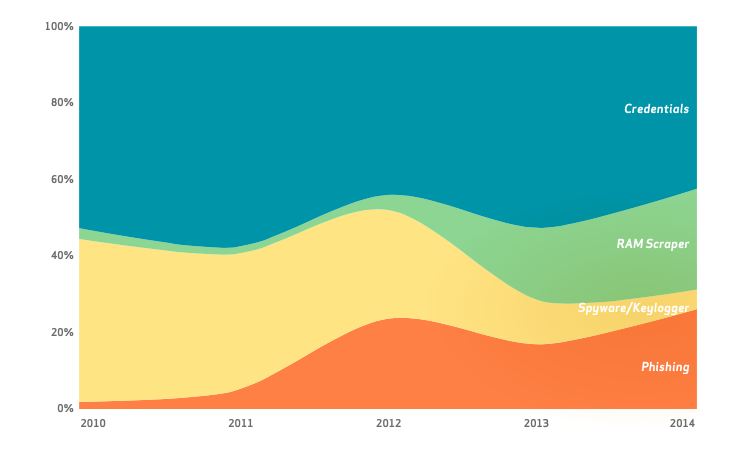
    First, I learned that Verizon publishes an annual report on data breach. This report which is written wittily and is easy to read (thank goodness for that) gives you a clear picture on main security breaches across different industries and platforms (desktop, mobile, Internet of Things). The following graph shows the breach trends over the past 5 years and for me it was one of the most interesting graphs through out the report. As you see RAM scraping and Phishing are major and growing problems:

    Significant threat actions over time by percent
    Verizon report, data breach trends

    RAM scraping is the type of malware that mostly targets credit card numbers at point-of-sales (POS) systems during milliseconds that it’s stored unencrypted in the back-end server’s memory for processing the transaction. RAM scraping has been identified as the primary reason of of high-profile retail data breaches such as Target and Home Depot. While email has become an essential part of our day-to-day work activities, Phishing has also become one of the easiest ways for criminals to load malware to a computers and spread it around.
    RAM scraping is the type of malware that mostly targets credit card numbers at point-of-sales (POS) systems during milliseconds that it’s stored unencrypted in the back-end server’s memory for processing the transaction. RAM scraping has been identified as the primary reason of of high-profile retail data breaches such as Target and Home Depot.

    Often an attack takes advantage of multiple techniques to target a primary victim and use it to further the real attack on its final company. Case in point, Target breach started with a hacked vendor — a heating and air conditioning company that was relieved of remote-access credentials after someone inside the company opened a virus-laden email attachment. Few days later, Target announced that attackers had stolen more than 70 million customer email addresses. The report shows nearly 70% of the attacks takes place on companies to use their compromised servers in denial-of- service (DoS) attacks, host malware, or be repurposed for a phishing site in order to attack another company. How awful!

    Mobile security (Android vs Apple)

    One of interesting part of the report and the subsequent panel discussion was the lack of serious threats on mobile phones. Above graph showed the main trends in threats and attacks on Android or iOS ain’t one of them. A closer look at all these attacks showed that Android phones have been more targeted than iPhones but most of attacks are short lived (less than a month until they fade away). One reason for lack of threats is the huge diversity among consumers’ hardware as well as different running version of OS on hand held items. Penetrating these many different phones and systems where no real financial gain opportunity is available (and there are so many easier ways to do so) has made hackers wary of targeting phones.

    However this doesn’t mean mobile is going to be a safe haven in the future. There is a good chance that enterprise mobile devices will be a good first target. Mostly because targeting one specific device model and OS will yield access to large population who’re using same or similar devices. Another area is older and more vulnerable protocols and technologies that have not been properly patched up. For example many companies are still using older (and often free) bluetooth technology that is very easy to penetrate. In fact Verizon report mentioned that 99.9% of vulnerability exploits happen more than a year after the vulnerability was disclosed!

    In the end involving security/IT team into the product development process early on as well as informing and educating mobile users on how to use their phones safely will be the most effective in preventing further attacks.

  • All resources I know about Product Management

    Product Management is still a relatively new field and each company depending on their product, culture and how they work have different job descriptions for a Product Manager. What are the key responsibilities of a PM and how can you build up skill sets required for the job? More importantly where to start?

    Whether you’re trying to become a product manager or you want to deepen your knowledge, there are so many resources out there to help you. When I started, I wanted a concrete understanding of PM role and to get a hang of all scattered resources over the internet.

    So I began searching, I read many blog posts and joined multiple PM groups on Linkedin and finally completed a very expensive Pragmatic Marketing course to get a feel for what PM is really all about. And when I was searching for books, articles, people on the topic I ended up with multiple recommendation for Pragmatic Marketing as a go-to training course for PM, Crossing the Chasm as “the” book for understanding concepts and people like Ken Norton and Marty Cagan’s SVPG blog as ultimate PM authorities. These are all great recommendations and definitely help but I find myself learning and relating a lot more when I find blogs of people learning out loud.

    Over time I’ve slowly built my own understanding and knowledge repository of what PM is, what skill set is needed and how to find answers and I want to share it with you. Take a look at Product Management Resource page. This page is going to be an ‘in-progress’ page and I will add to it as I learn.

    As I find more and more interesting things to read, learn and digest I keep reminding myself information overload is real and there is always more to learn and read than I have time to spend on butI’m not in a race I am here for the ride 🙂

  • Product Prioritization or how to be a curator

    I am reading the wonderful Rework. One topic that stands out for me is their emphasis on being selective on product features. They basically argue that building a good half product is much better than having a half-ass whole product. How true!! but what causes a product to end up being the latter and not the former? No one intentionally starts with the goal of building some thing mediocre.

    So what cause products to bloat?

    One of the best explanation I came across is a blog post called “Product Strategy Means Saying No”. It enlists the arguments product managers and executives use to add more features to the product. I myself am guilty of making “But our competitors already have it” argument without completely being able to justify why it’s important to have all those competitors features.

    If I would add one more argument to the list, it would be “Let’s hack this quickly NOW so we look cool then we’ll fix it later” and “Later” never comes. This is called “shiny object syndrome” but once the hacky feature looses its coolness and some other cool thing pops up suddenly no developer has the time and willingness to fix it. Users and customer support are forever stuck in a loop with this piece of crappy code.

    How to avoid building mediocre bloated products?

    If you’re building a new product, assuming that you have identified customer pain points start with the core one. What I mean is that the founder (which in my mind is really doing product management) must have a system to identify out of all identified pain points which one is most important one to address first. If the founder has experienced these pain points herself and has observed how users currently dealing with these paint points, it should not be difficult to figure out what is the most pressing issue to fix.

    Much has been said about “Lean” methodology but in my mind it all comes down to figuring out the burning problem and build core functionality to address that problem only. This will be the product’s epicenter and as the product is being used by customer it will grow and evolve. But this approach create the main building blocks that ultimately create an awesome half product that solves one problem and does it very well!

    What about mature products that have been around for a while? The ones that still provide value to the user but they’ve been so diluted that it’s hard to pin point its usefulness. I’ll talk about that feature audit and prioritization methods to fix these type of products in the next post