Author: sogolf

  • Building an AI vs a regular Product

    I’m learning more about building products infused with AI. What does an AI product mean and how building it is different from building a regular product? You can differentiate an AI product vs a traditional product through the following criteria:

    AI product starts with existing technology

    Traditional product development cycle starts with understanding a specific customer or business problem. Once the problem is identified then Product, Design and Eng work together to build a solution that satisfies that problem. However contrary to traditional product an AI product starts with available technology and it’s Product Manager job to find use cases solving or improving customer or a business problem using that technology. I heard from a PM who worked at Google that for a long time they had voice-to-text technology but didn’t know what to do with it. They iterated quite a bit from trying search by voice in browser to other features until they developed Google Home, a smart speaker designed to respond to voice commands. Though voice-to-text is not much used in browser because of easy access to keyboard, voice control is now an integral tool in our everyday tasks to search on TV or interact with smart devices.

    AI is here to make the solution smarter

    While a traditional product provides solution to address pain points, AI use cases are usually applied on top of it to make that solution “smarter”. This mean looking at patterns and trends within the existing data to to either optimize the solution, provide recommendation and insights or make the solution customized at scale. I use advertising industry where I work to provide an example of each use case.

    I work at a digital advertising platform that helps brands and agencies run advertising campaigns across internet. In advertising ecosystem content providers (such as New York Times, Netfelix, Walmart) initiate a bid request for ad placeholders on their website, videos, podcasts etc while companies like mine responds to those bid requests to place a variety of ads in those inventories:

    • Optimization: Advertisers have a budget to spend for campaigns and along with it a set of objectives and key performance indicators, such as maximizing conversions, clicks, or visibility. They want to ensure they maximize return on marketing dollars while achieving these goals. It’s the system responsibility to determine the most effective bid amount to maximize the chance of wining without overpaying. The system analyzes data such as historical performance data and user behaviour among others data types and uses machine learning algorithms to predict bid outcomes and make real-time adjustments based on this data and campaign goals.
    • Recommendation: One of the main goal of advertising is to reach the right people looking for the solutions/services advertisers offer. Advertisers have specific criteria on who to target based on geographic location, demographics, user’s action etc. To expand their customer reach, advertisers look for recommendations on other groups of people to target. The system use the characteristics, behaviours, and interests with an existing audience and use them to identify and recommend new users who closely resemble the seed audience based on these characteristics.
    • Personalization: Personalization has become increasingly important in advertising because personalized ads increases consumer engagement, brand loyalty, and overall marketing effectiveness. Machine learning solutions can be used to create various versions of a creative and messages based on user’s data and past behaviours in mass scales.

    AI solutions have existed for a long time without being specifically called AI, while generative AI solutions exploded more recently with introduction of chat GPT and other large language models.

    Many AI solutions have minimal User Interface

    While traditional products have strong element of UI where the user gets to interact with it to derive the value, AI solutions usually don’t offer much of a UI. While massive amount of data and models goes into building and generating optimization, recommendation or personalization services they’re usually behind the scenes and is transparent to the user. AI recommendation Generative AI interaction is conversational text based and is mostly done through the prompts, voice though the field is quickly evolving and we may witness more interaction.

    Having above categories have helped me to quickly identify if I’m dealing with a traditional product or if the product is AI based. I hope it helps you too.

  • Using AI tools for Product Management use cases

    My blog has been dormant for quite sometime but it’s Jan 2025 and the plan is to revive this blog with more frequent but shorter posts🙂

    The past two years has been a dizzying nonstop torrent of news of AI related innovations and products. What does this all mean for Product Managers and how can they be leveraged to facilitate, accelerate some aspects of the job?

    While I still firmly believe that as a PM you are responsible for thoroughly understanding the problem, there are many aspects of product discovery that takes a long time. Many generative AI chatbots such as chatGPT, Perplexity AI can be effective tools that help speed up the process. Here are a few use cases I have tried:

    Brainstorm ideas

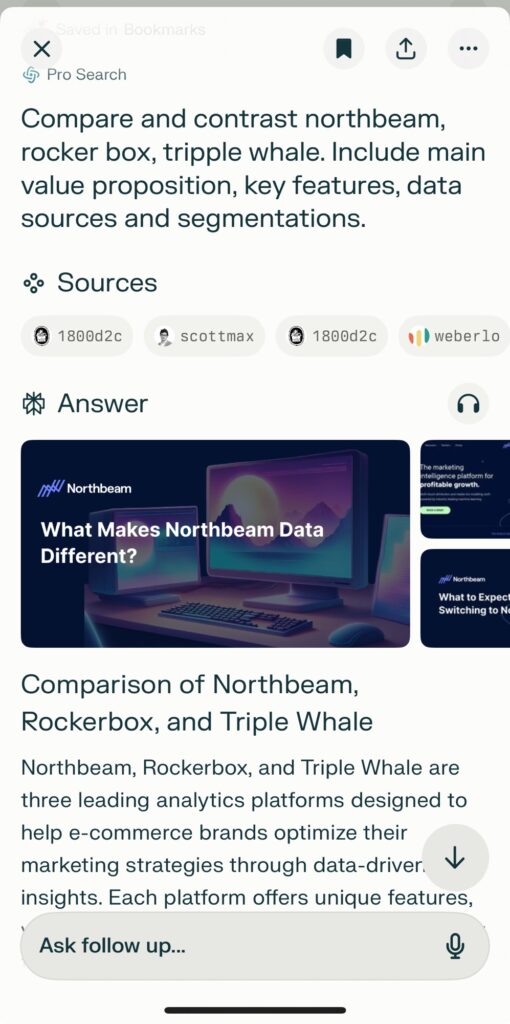
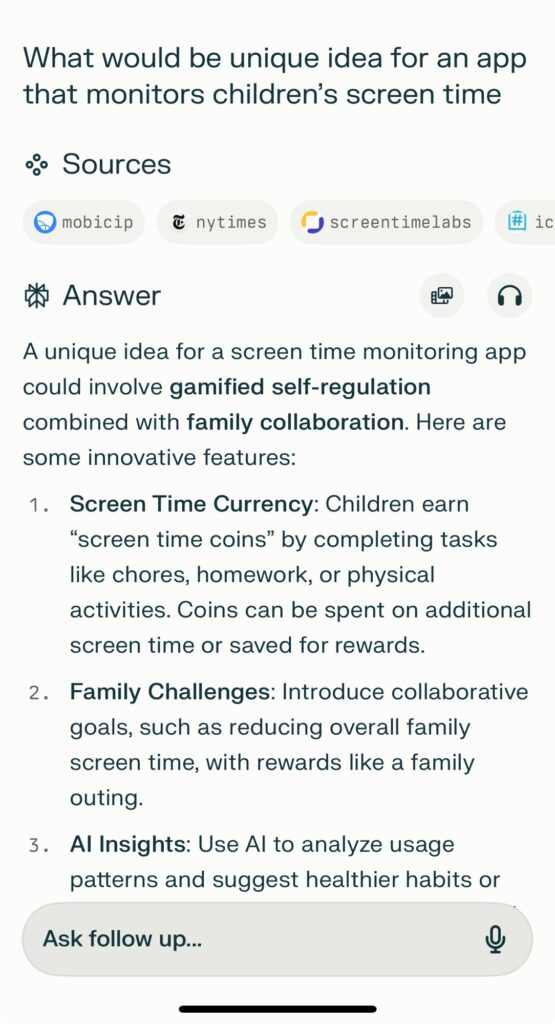
    AI tools can help to generate ideas for a new product or service in a specific industry, or for a specific target audience. Don’t expect miracles but as a tool to help you think about a space in different ways and spark new ideas instead of coming up from scratch.

    Sample query I did on Perplexity AI

    Customer Segmentation

    Use chatGPT or similar tools to get a better understanding of different groups of users. Again as a research tool it may come up with some groups of customers that you couldn’t find right off the bat yourself.

    Competitive Analysis

    I also find that AI can be a great assistance in conducting competitive analysis as it quickly can show the key features, strengths and differences between multiple competitors offering.

    In summary although there are other use cases like writing product requirements or codes that I haven’t fully explored, I think for ideation and research AI tools will be essential to use going forward.

  • Women, Life, Freedom

    I have been completely silent for the past year and a half. After the birth of my second child I took a year of maternity leave which left me out of workforce and away from what was happening in Product Management world. Pandemic also left me exhausted feeling that I need to simplify and focus on fewer things.

    However here we are! The reason for this comeback post is two fold: My world has been rocked since the protests broken out in Iran in September 2022 and I need to record and remember how I feel about all of this and I still care about this blog and love to share what I learn along the way even if I’m slow at it.

    What is Women, Life, Freedom about?

    You may have heard about the death of Mahsa Amini, a young Iranian girl beaten and killed by morality police and the protests that has erupted since Sept 2022. So far around 20,000 people have been arrested, raped and tortured. 500 + people have been killed (including 60+ kids) and 4 protestors were executed behind closed doors through forced confession, a hurried sham trial or access to a lawyer. The revolution is still going though the dictatorship acts with such brutal barbarity that is astounding even by Islamic Republic standards and western countries indifferently standing back and looking in on the ongoing the bloodshed. But let’s unpack this mess a bit more:

    I have a confession to make; I’m deeply uncomfortable around police officers. If I see an officer approaching me I clam up, my heart rate goes up, my hands sweat. Even if he smiles and ask me questions in a friendly tone I can’t seem to smile back I answer them concisely and curtly as my throat gets dry. I’m nervous and want this conversation, this interaction to be over, I want them to go away. Having Police officers or anyone in official uniform for that matter doesn’t elicit any feeling of safety in me at all but why?

    It goes back to my past experience growing in Iran. Growing up we were forced to have hijab, to cover the hair and dress modestly (this meant wearing shapeless long smock over your cloths). It didn’t matter that you didn’t believe it, you didn’t care for it, it was the senseless law that was severely enforced even though the government was much more for lax about enforcing other important laws or managing the country for that matter. So when you were outside say walking in the street, shopping or eating in a restaurant if you were a young girl specially unaccompanied by parents or older folks when you see a police officer (angry looking officer or a woman in chador) you knew it was trouble. They asked you to pull on your scarf forward so the hair doesn’t show, they asked you why the smock is not long or loose enough and it showed your body and if you had make up they handed you a handkerchief to wipe it away. Argue back and you’d be taken many times forcefully into the police van and withheld in police station until an elderly male figure of the family comes, pays a fine and bails you out. I won’t even start about police raiding your home if you were to have a party with boys, music and booze!! These two comics from Persepolis by Marjan Sartapi really sums up the experience.

    Iran’s Islamic rules have been suffocating for a long time: As a women you need your husband’s, brother’s or father’s permission to work, go abroad, you can’t divorce your spouse (he has the right to divorce you) or have custody of your children. You can’t be a judge cause you’re too emotional! or study mining cause its too masculine! You can’t sing and very recently you cant access birth control pill cause hey supreme leader wants to triple the population.

    All these experiences have been table stakes in Iran for the past 40+ years but for the past 4 years add to the mix the extreme government corruption, a crippled economy resulted from crushing sanctions of Iran nuclear deal, pandemic and lack of vaccines and Islamic government’s very own revolutionary guards shooting down PS752 airplane full of innocent people and you get a better picture on why Iranians can’t take it anymore. Even though I don’t live not in Iran anymore I really identify with the sentiment of “I can’t breath”. This dictatorship must go and something better must replace it.

    This is why you see pictures and videos of so many young people specially women risking their lives to come to street to remove and burn their headscarves, cut their hair and protest. They know first hand to expect beatings, rape and sexual assault from official police and plain cloth militia, imprisonment, solidarity confinement and heavy handed sentences that leaves unable to study, work or leave the country but they still take take part. This is why for the first time in my life I can’t stay on the sideline anymore. All my life I thought if I put my head down, work hard and stay out of regime’s way I can have a fulfilled, normal life but I’m not sure anymore. It seems that the more you try to stay out of regime’s way the bolder they get to crush your neck until you can’t breath anymore.

    All the photos from Twitter as journalists are not allowed. Don’t know the photographer.
  • Leveling Up From Product Manager To Product Leader

    I have previously written about why it’s so hard to jump from a senior product manager to a product leader. Here is what I wrote:

    The catch is you can’t advance to the next level (becoming PM lead) just by doing what you’ve done up to now in a more complex/bigger scale. As a product lead you fundamentally need a different skillsets that you haven’t invested on acquiring.

    In that post I provided strategies to prepare you for this transition and even though those strategies are still relevant, I attended a talk by Jules Walters on Industry Conference this April on this very topic that made the advice crisper and better. When Jules got promoted from a Senior PM to a Product Lead in Slack he struggled to keep up with the new job. He eventually realized he needed to make these key transitions to become a successful product leader.

    From direct to indirect Execution

    Product managers at every level are expected to demonstrate leadership but as a junior product manager you are certainly tasked with more execution than leadership. When you become a product lead “people management” aspect of job becomes much more prominent. Now you need to allocate your time to hire people, set goals and and manage your team to deliver results which means you have less time to manage products directly. To transition from a direct to an indirect execution you need to identify people who are willing to take on more and mentor them so you can delegate. It also means to create a system to share context with others (a consistent way to describe the problems we’re solving, why we’re solving it, the solution outline etc) so they can make the right decisions.

    From team-focused to cross-functional Leadership

    When you are a (senior) product manager your focus is your team or teams you’re working with however when you become a product lead, building trusted relationship with teams becomes ever more critical because at this point your product is understanding and finding solutions to the needs of other teams across the company. You need to understand align with them in order to resolve dependencies and pushing forward. To transition to a cross-functional leadership you need to develop mass communication to keep everyone on the same page and provide context by telling simple and memorable stories.

    From Consuming to Influencing Company Strategy

    Understand other areas of your company and explore ways to influence them. At this point your focus should be to understand the business and how the product contributes to the business deeply. When you have a clear grasp of the business your goals will be aligned with the CEO. Set aside time to think strategically to come up with big picture projects and goals and get buy-in from other teams to execute them.

  • Two great PM reads

    When I talk to people who are curious to learn more about Product Management one question keeps coming up: “What are the resources to learn about Product Managment?” I have a dedicated page on what I’ve found as valuable resources for PM and I update it frequently. Recently I came across two more that I want to tell you about:

    Bringing the Donut

    Bringing the Donut: Read the articles on the website and do yourself a favour and subscribe to the newsletter. You’ll find the articles long (in a good way that goes in depth as oppose to shallow reads with click-bait titles) are insightful!

    Hardcore Software

    If you like me got your CompSci bachelors degree a while back Hardcore Software is educational and oh so much fun to read! Sinofsky walks you through his career path in Microsoft, behind the scene Windows and other product launches and you get to see even when there was no official product management in place how its principles still plays out. I am really enjoying myself reading the chapters as they get published out!

  • Kill your darlings!

    I just finished Stephen King’s superb book “On Writing”. For someone who’s not a fan of King’s horror stories I thoroughly enjoyed it and came across this quote:

    Kill your darlingskill your darlings, even when it breaks your egocentric little scribbler’s heart, kill your darlings.

    I later found out this is one of the most frequent advice given to writers and I think one that can be 100% applied to product managers as well. First though let’s see what are darlings and why should they be ruthlessly killed?

    What King means by “darling” are those storylines, characters, or paragraphs that a writer works hard on and is often most proud of. S/he loves them, to the point that she almost doesn’t care if those bits are clear to readers or not. She loves them, and wants to keep them even if it makes the overall story worse! Dear product manager does this tale sound familiar to you? 🙂

    One of the common mistakes we product managers (and product designers) make is getting attached to our darlings. It’s understandable! Coming up with a solution takes creativity, time and energy. When you spent many hours crafting one into a workable requirement doc or a design, it can be really easy to get attached to it!

    When you fall in love with your solution if someone gives you a feedback at best you argue your hardest to justify its existence and at worst you get defensive and block the critique even when it can help you. Getting attached to a particular solution will also prevent you from seeing better solutions out there if you tried to tackle the problems from different angles. However the biggest danger of it all is if our solutions only make us happy but fail at the problem-solving then we are failing miserably as product managers!

    Therefore it’s imperative that you are willing to “kill your darlings” on your route to find the best possible solution to your user’s problem.

  • Making Hard Choices as a Product Manager

    making choices
    Image by Nathan Dumlao through Unsplash

    I was at an event where the keynote speaker told us when asked by his young daughter on what he does as a product manager, he said:

    “My job is to make a lot of decisions every day.”

    Although there are other ways to define what I do day-in and day-out, I often think back to this quote. Even though product managers don’t build the product directly, they make decisions which helps the teams and enables them to get things done. One of the biggest values a product manager brings to table is providing clarity which is the result of an informed decision by an opinionated product manager. Avoid these mistakes when you are making a decision:

    Don’t try consensus decision

    At first glance finding solutions that everyone actively supports seems like a great idea but consensus decision has two major drawbacks. The first one is not everyone wants to be involved in decision making. I know people like Marty Cagan advocate engineering involvement in product discovery but in my experience few engineers are interested or have the time to observe how users interact with a product or be involved in product discovery. Second and bigger problem in my experience is reaching consensus is near impossible! No matter how much you spend time on it by nature different departments have conflicting demands; Sales wants feature X as soon as possible but Legal won’t approve it until regulatory features Y, Z are added to the mix. While you are trying to involve both group and find a compromise the engineers are waiting on which feature to build!!

    Collaborate closely with a few key stakeholders and understand their must-haves but the decision on what to build and in what order is yours alone. Know that everyone will NOT be happy with your decision but for your unhappy stakeholder you owe them a justification of your decision and should manage their expectation.

    Don’t take too long to decide

    Unless what you’re deciding on is high stake don’t spend too much time on it. It takes a REALLY LONG time to involve everyone, get their input; when coming to a conclusion prolongs it zaps the energy and momentum out the team involved. I was once tasked to build an application system that authorized various groups of users and provided different access level to them. The architect involved was to select the suitable authentication and authorization tool to do this. He wanted to pick the right tool because the company was going to use this authentication and authorization framework for years to come. However he obsessed over this decision by taking months to analyze and compare various tools. By the time the final decision were made we had so many false started that engineering team was already fed up with a project that hasn’t even started yet!

    If your decisions can be easily reversed make them as fast as possible. Even if your decisions have high impacts for the business, do your due diligence gather up data, talk to people and do your competitive analysis but put a time limit on this process and when the time comes make as informed of a decision and move on with your decision to enable your team to get the ball rolling.

    Don’t second guess your decision

    Once you made your decision you need to commit to it to allow it to succeed. Second-guessing yourself lowers the odds of success and makes you look uninformed and haphazard in your decision making process. This doesn’t mean that you shouldn’t change course if new valuable insight comes up but questioning the wisdom of an agreed-to decision weakens the trust and alignment you worked hard to build with rest of the company which lowers the odds to succeed. Once you make a decision, commit to it.

    Even though the above list by no means is exhaustive list things to avoid they have been helpful guard rails for me. I want to leave you with a list of excellent and quite useful articles on this very subject including 10 Habits for Making Wicked Hard Decisions by Gibson Biddle, Making Good Decisions as a Product Manager by Brandon Chu and finally a fascinating TED talk from Ruth Chang that explains why hard choices are hard.

  • What got you here won’t get you there

    Jumping through a gap
    source: Thanks to Blake Cheek from Unsplash

    I want to let you in on a secret that no one warns you about: A gap on your path from a Senior Product Manager to a Product lead (or Director of Product) exists and you won’t see it coming!

    The story goes like this: At the beginning as an Associate/Junior Product Manager your job is to execute on the solution outlined for you. You work with a small engineering and design team to build a product where its features and functionalities are mostly defined and you get evaluated on the product you shipped. As you progress in your career you take on more challenging problems. This time you are the one working on a couple of projects concurrently in one area defining the features on one and coming up on a road map for another one. You work with bigger engineering groups and you’re responsible for Take to Company and/or Take to Market plans as well. But at the end of the day you are still being evaluated on what you shipped in your area.

    The catch is you can’t advance to the next level (becoming PM lead) just by doing what you’ve done up to now in a more complex/bigger scale. As a product lead you fundamentally need a different skillsets that you haven’t invested on acquiring. Here are some of the hurdles you will came across:

    1. You have expertise​ in your area but you are far less knowledgeable about other areas of the business. This means that while you present a road map for improvement in your area you don’t know the impact of these suggestions on the overall business.
    2. You worked in your role as an individual contributor which means ​you’re responsible for your work but don’t have experience managing a team directly and be responsible for their results and accomplishments as a team.
    3. You know how to effectively lead a cross functional team and influence your peers but you don’t know how to influence other executives.

    What to do to overcome these hurdles?

    After reading and thinking about these issues here is what you can do right now to break through them:

    Tour of Duty

    I learned this from Jonathan Nightingale’s excellent talk in Product Tank Toronto. Instead of having a vague, unactionable 5 year plan, have a specific career goal and plan your next 12-18 months to achieve it. To overcome issue 1 above put yourself in situations where you learn new skillsets and experience different types of product problems. For example if you’ve worked so far on “feature work” for your next role (aka tour of duty) look for “growth work” or try “scaling work”. This will expand your toolbox and help you identify which type of work is needed for a particular problem. When time comes you to lead your team you can help them pick the right solutions without getting into the weeds of the work itself.

    Mentor Others

    One of the most common traps is to keep the most important projects for yourself. You’re thinking: “This is important, I can create a better outcome myself, therefore I should do it.” But doing so has a big opportunity cost as it keeps you in the weeds and takes time away from you learning other things (obstacle #1). Mentoring others is a powerful way to combat this issue.

    Mentoring others not only is personally fulfilling and helps you learn about managing other individuals but also teaching someone to get better at something you do well helps you to delegate that work and take on new responsibilities.

    Be a Thought Leader

    Contrary to programming or design, it is hard to demonstrate you are knowledgable in a tangible way in product management. Maintaining a blog or some sort of outlet to record your thoughts, opinions and learning is one of the easiest and most effective ways to show you know what you’re talking about. What is quite striking to me is that how few PMs do this! If you want to go to next level you need to demonstrate you are a thought leader. So write a blog post, speak in related events, answer some Quora questions!! Not only you are giving back to the community but also you are practicing how to lead and influence others with your work!

    None of my above recommendations is a guarantee for your next promotion however they are all actions that are within your control. If you read this article and find it useful I would love to know what are your recommendations for jumping through this gap and landing successfully the other side!!

  • Is It Even Possible to Focus on Anything Right Now?

    I want to acknowledge the strange times we’re in. Lives around the globe has fundamentally changed since March when World Health Organization (WHO) announced COVID-19, a pneumonia-like disease attacking respiratory organs, a pandemic.

    Like everywhere else in the world here in Toronto, we’ve been under lock-down since mid March. Everyday routines are thrown out of the window and joggling remote work with homeschooling, child care and house chores while receiving a constant torrent of bad news has become our new reality. If you are like me, one detrimental result is that it’s harder than ever to find the focus to be productive.

    To find answers, I I experimented with different approaches and also came across excellent articles in Harvard Business Review and WHO. Here are 3 actionable takeaways from what works for me. Hopefully you find them valuable too:

    Restrict your news intake

    Yes, it’s important to be informed about what’s happening so you can form a plan and yes it is also normal to feel sad, stressed, confused, scared or angry about all the changes. However following the news and social media excessively quickly turns our thoughts darker and create anxiety about the worst case scenario. What is proven to be an effective tactic is to minimize watching, reading or listening to news. Get your updates at specific times during the day, once or twice from a trusted source (which is not social media!). When I started feeling drained, hopeless and depressed about all the bad news I decided to completely avoid Facebook, Twitter and Slack. I figured that big news will seep through to m e through family and friends so I blocked off all my regular sources of news for some time to make sure I can cope.

    Create a new routine

    In addition to complete disruption of your normal schedule if you have kids unless you are an experienced teacher you are now charting unknown territory of homeschooling!! Consider creating new routines for your kids and build your work day around those routine! I learned from my daughter’s teacher to build variety into her schedule so she does a daily mix of reading, math, art and physical activity. Since she’s in grade 2 there are a few activities that she can do unsupervised while she needs assistance with others. Here is a snapshot of activities from each category and I mix and match them to come up with a daily schedule.

    Be patient with yourself

    Take care of yourself at this time. Eat healthy, sleep, exercise and be in touch with your loved ones and friends. I call my friends and have a good conversation, these days no body is going anywhere so take advantage of that! Also find opportunities to look at positive and hopeful stories, my favorite. Some Good News on youTube is an awesome one to check out!

    Finally recognize your limitations and adapt based on the situation. Show yourself the same compassion you would show someone else in your situation!

  • Review of “Shape Up” book

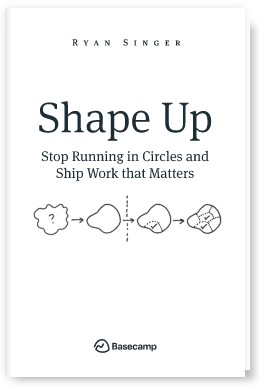
    I enjoy reading books over blog posts and tweets because they provide more context and they can also go deeper. I recently finished reading “Shape Up” written by Ryan Singer. The book is available for free on Base Camp website and it definitely worth a read. Here is my take on it:

    What is Shaping Up and why does it matter?

    The book argues there is a Goldilocks state for defining requirement in a way that defined work is neither too vague nor too concrete. The idea is to provide the team (1-2 developers and a designer) enough context about the project’s goal and clear layout of the scope and constraints but allow them to define the nitty-gritty details themselves. I strongly agree with this approach as I made both above mistakes.

    Having too vague of a requirement (“This page should be easy to use”) leaves the team guessing on what the PM really wants. They either constantly interrupt their work for further clarification or they may build based on their own assumption. Either way the end result is either something that took much longer that it needed to or worse an application that is totally different from the PM expectation.

    The other extreme where the requirement has all the details (“Here is the exact designs for registration page”) brings its own risks. The biggest one is to create an illusion that PM knows all the answers and the team has no say in figuring out the direction of the product. The team job is only to follow strict set of instructions to get to the final product. If user experience or the flow doesn’t make sense then it’s on Product who should have should have figured it out sooner. This approach takes away the joy of collaboration, leaves the PM anxious about guessing everything upfront and the team powerless in coming up with solution.

    What I learned & loved about Shape Up

    The first part of the book talks about the characteristics of a shaped up work and how one should go about creating such work. The first thing is that the work should be completed and shipped within 6 weeks. I learned there are four main steps to follow: 1) Setting Boundaries which focuses on defining the problem 2) Rough out the elements is about sketching a solution without specifying too many details 3) Address risks and rabbit holes finds unanswered questions in the proposed solution to de-risk it and finally 4) writing the pitch is simply creating a document where all the above is laid out so that the team can understand them.

    What could have been better

    In summary Shape Up specially it’s first part is a must read for every product managers whereas other parts are less in control of the PM. For example, the book talks about the concept of circuit breaker (abandoning a project which has run through its 6-weeks cycle but it’s not completed) but that truly depends on leadership willingness to pull the plug and enforce that deadlines are firm. I haven’t seen that happening much in my experience and it’s not something that PMs can enforce by themselves.

    Another issue I haves is that the book comes us with some new catch phrases like “six week cycle”, “cool down period” and “betting table” but I’m vary of coming up with new hypes and new names. These terms tend to take a life of their own as the spread to other companies and turn into something quite different. I’ve seen this with concept like MVP, sprint, JTBD and my concern is that they will have the same fate.

    Overall though it’s one of the best free books out there that really teaches you something 🙂