Category: startup

  • 5 Tips for Managing Products Remotely

    After reading A Year Without Pants I became interested to know more about remote work and specifically how it works with product management. What qualities are required? What are the advantages and disadvantages? so I did some research such and interviewed a couple of my colleagues who work remotely as Product Managers. I like to share what I learned along the way with you. Let’s get started:

    The practice of working remotely has been on the rise for sometime. In US alone, number of people who regularly work-at-home has grown by a whopping 103% since 2005. (For more interesting data take a look at latest Telecommuting statistics). There is no denial that work from home is a real attractive option and if you need more convincing reasons just read the book Remote. I myself dream of working from home where I don’t need to commute to work everyday (specially in winter time), I can get something done without getting interrupted multiple times and have flexibility over my schedule.

    However most of the telecommute jobs I have seen are for well defined jobs such as software engineers, designers and customer support members.  There are few remote product manager jobs out there and I have always been wondering why? Can it be that there is no need for product managers in companies where work is done 100% remotely?

    I believe the answer lies in company’s size and maturity and not on how it’s distributed. In small companies with a single product and  a small team, different team members take on additional responsibilities to divvy up the work. Usually the founder who is also the CEO takes on responsibilities such as talking to customers and defining product vision. Then designers and developers are responsible for turning that vision into workable software. In this setting, the product management role is distributed among the team and no single person is responsible for the job.

    However as soon as the company grows and the product becomes more complex the work itself becomes too much of an overhead to do for designers, developers and founders on top of what their main responsibilities. Someone needs to clarify Who we are building for and Why to free up the rest of the team to focus on How. This is when Product Manager is added to the team. (Take a look at black box of product management article for an in-depth explanation).

    So if being a remote team as oppose to a co-located one has no effect on having a product manager role, how does remote product management work? What qualities are required? What are the advantages and disadvantages? I sat down with three of my colleagues who all work as Product Managers remotely to get answers to my questions.

    For my first interview I talked with Alex whom I had the pleasure of working with for a long time at OANDA. OANDA’s main focus is currency trading and its popular online trading platform known as fxTrade enables trading volume of several billion dollars a day. Alex has been working remotely for the past 6 years and he currently manages fxTrade across all platforms (Web, Mobile Browser, Mobile App). Design and development are all centrally done in Toronto. Alex travels every 2-3 weeks from San Francisco to Toronto and stays for a week.

    Then I sat down with Barbara who works as Product Manager for Mozilla. Barbara works on Firefox browser for Android app. Her development team is geographically dispersed across the globe. Barbara is based in Toronto but she travels once a month to one of Mozilla offices in States and stays with the team for a week.

    My final interview was with Saeed who works in Product Management at Informatica. Informatica provides solutions around data for the Cloud, big data, real-time and streaming. Saeed is based in Toronto but his team is spread across India and in northern California. Except for annual planning meetings in Informatica headquarters he does not travel.

    Top 5 observations about working as a remote Product Manager:

    Here are the most interesting things I learned through my interviews:

    1. We all work remotely to some degree

    “Business expand across locations. With the exception of small companies, where everyone is in one location, as a Product Manager you have to work with remote people and teams… and of course, customers and partners are NEVER at HeadQuarter. 🙂 “

    When you come to office even when you are co-located with the development team, you need to work with other parts of business such as Sales, Marketing, and Customer Care which may be at different locations and time zones. So being able to work with others through email, phone, chat or whatever remote communication channel is a must no matter how you work.

    2. Communication and Collaboration

    “None of the team members I regularly work with are in the Toronto office, pretty much 99% of my meetings are held over Vidyo (a video chat system used at Mozilla)…We [also] heavily use IRC and Slack, as well as Bugzilla and email to communicate.”

    Email, phone, video conferencing and instant messaging (Slack being the most popular one) are used for communication with team members. However what is more important than choice of tools is to make sure crucial information isn’t lost between colleagues. Barbara and Alex find traveling at least once a month necessary to make sure that everyone in the team is in-sync.

    For collaboration, screen sharing software like WebEx, project management tools such as Trello and wiki softwares to quickly edit content like Confluence and Google Docs are all part of the remote toolbox. Good written communication is the single most important skill to make sure everyone has a shared understanding of what the ask is and how to provide a solution.

    3. Trust is the Key

    “I have built a close relationship with my team over time and now I trust my them to know my vision really well… I’m confident that they will be able to represent and defend this vision to others during a meeting when I’m not in the room.”

    Product Manager has to earn the respect and trust from the programmers and designers. With trust, PM can discover how to get the best possible work from the team. If there is clarity on the goal and a criteria that defines it, then we can speak the same language about what we need to do to get there. This issue becomes even more important when you work remotely as you need to build relationship over time and and you need to make sure you can effectively convey the vision to everyone on the team.

    4. Biggest Advantages

    “I can be more productive because I’m working somewhere else. I don’t get pulled into meetings where I can’t contribute mostly because I’m not in the office. As a result, until something important comes up that needs my attention I don’t get called into meetings.”

    One thing that stands out in addition to all of the advantages of remote working, is the fact that you don’t get tied up with unnecessary things to do inside the office. Instead you can use that time into do some strategic activities like talking to customers, delving deep to understand the problem and figuring out product/market fit. These tasks require long and uninterrupted attention which is something that gets harder to come by when you work in a room with 10 other team members and a constant flow of chatter and calls.

    5. Main Drawbacks

    “There are advantages to working in the same office as the product team. It’s very easy to get the group together to discuss an urgent issue. The proverbial “water cooler conversations” are only possible when you are co-located. There is a lot of information that can be gained simply through casual discussions, having lunch with someone or even “overhearing” something in the hallway. And quite honestly, having timely information IS very important managing products.”

    This quote definitely captures two themes that keep coming up. The first one is you can’t walk into an office and give a brief about what was just decided in another meeting. This disconnect can lead to informational asymmetry and misunderstanding. You have to be very disciplined in dispersing information. Sometimes you need to set up multiple meetings just to convey the same info because it’s hard to set up a meeting that works for everyone. Another important thing is to have a central knowledge repository where everything is organized and be vigorous to keep it up-to-date.

    Finally emergency situation or when a project needs a lot of coordination from multiple teams having an on-site team is so much easier than orchestrating activities between multiple time zones, and only being able to rely on chat, phone and video to work things through.

    Conclusion

    All in all I think working as a remote product manager is not fundamentally different from working with a co-located team.  There will always be a sense of FOMO (fear of missing out) when dealing with remote teams, so over-communicating is often better than assuming team members will find things out through other means. You also have to work harder to build the relationship and get used to different working styles of the team.

    Note about this post’s image: It is taken from Trello blog which has an insightful article about remote working.


  • Hooked: A Book Review

    What the Hooked book is about?

    hooked a habit forming product book reviewI recently finished reading Hooked: How to Build Habit Forming Products and wanted to share what I’ve learned from the book and answer the question if the book worth reading?

    The author Nir Eyal, who has an excellent blog called nirandfar.com (neat name, no?), looks into nuts and bolts of products which we spent hours of our time playing and working with. I believe he first self published the book based on his own research and posts he wrote on his blog but later the book was later got published through a publisher.

    I follow Nir’s blog also as it is focused on this topic and in I’ve learned interesting stuff (like messaging apps which I wrote about earlier).

    In my opinion this book is an extension of another excellent book Power of Habit which looks into inner mechanism of habits and how to use this mechanism to create a new behaviour or replacing an old one.

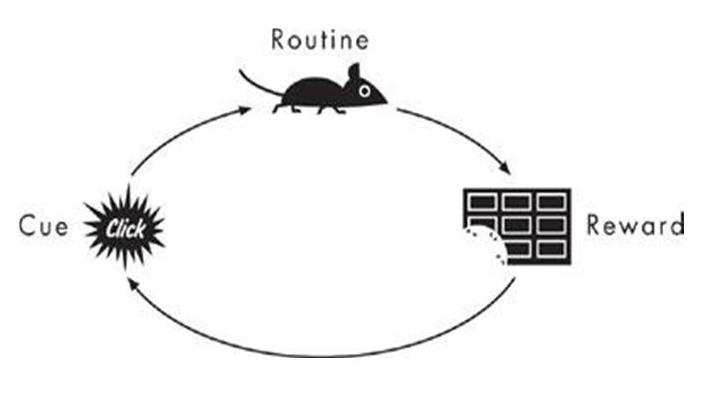
    In Power of Habit we learn that each habit or routine behaviour consists of 3 parts: 1) cue 2) routine 3) reward.

    habit-loop-charles-duhigg

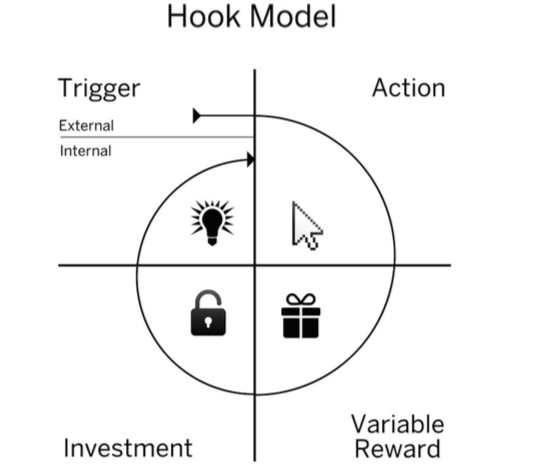
    Hooked looks at the above loop but with more detail and specifically from aspect of interacting with a product and he adds a fourth step to this loop:

    hook-model-nir-eyal

    So what are these 4 steps that we go through when we interact with sticky products?

    First one is trigger: Trigger is one thing that nudge us do some thing, this can be external and explicit like a button or a link with strong call to action or internal and implicit like a fleeting feeling of boredom or the need to stay in touch with friends. This usually makes us take the next step to either click the button or open facebook page to alleviate that feeling of boredom and loneliness.

    The key thing I learned from this chapter is to underpin the internal trigger through asking “Why” from users to understand the underlying their feeling (this is heavily emphasized in Customer Development book as well). Internal trigger is most powerful because it compels users to take action without any spending marketing dollar or nudge from product designer to use the product.

    Second one is Action: the steps you take within the application or with the product in hope of achieving results, getting  feedback from. This chapter makes it clear that user takes “action” when they have enough “motivation”, “ability” to do those steps and the “trigger. (Look at the Behavioral Model by venerable BJ Fogg). Since repetition is the key step in forming a habit, the easier the action the better chance of repeating it again in future. Nir shows interesting example of how producing content on the web has evolved from challenge of hosting a website to a few clicks to create and share content in Facebook.

    Third one is Variable Reward: Not knowing what to expect for reward or having a new kind of reward is the key concept in making users repeat their actions in hope of getting more satisfaction out of that action. For example constant scrolling on Facebook, Twitter or Pinterest happens because with each scroll user doesn’t know what type of update or interesting content s/he will face therefore it keeps at scrolling again. For more info take a look at this detail blog post on the subject.

    The last step is Investment: The last phase of the Hook is where user is asked to do bit of work. This last bit of the work is what makes the user to place more value in the product. The more time spent with one product and the more personal or professional data you put in, the more user become hooked with the product. It will also be more painful to leave. Why? because we value our effort more than it’s really worth and once we become familiar with one product they keep coming back to it. I think this can explains why financial analysts keep using arcade, difficult and extremely unfriendly Bloomberg machine as oppose to better designed, easier solutions.

    What do I think about the book?

    The good:

    • I liked the book even though I was familiar with the concepts explained in the book I like detail explanation of each part of a habit as well as lots of product examples accompanied book.
    • I also liked how Nir who started out as a person not familiar with the topic in a span of 2.5 years turned the table around, did all the research, self published the book and now is considered a subject matter expert in the field.

    The bad:

    • I started this book with a lot of expectation of more in-depth material perhaps because of my own fascination with behavior change topic I didn’t find a whole lot of new things in the book. I also found the focus of example mostly on consumer products. I wish there were more B2B example or at least more variety. There was too many reference to Pinterest for my liking.
    • I also found the end of chapter exercises too high-level and actually being able to work off of it. I myself always prefer detail, practical guides over to high level blueprints.

    photo credit: I used the hook model from nirandfar.com blog and the habit loop from power of habit book page. Hope it’s ok!

  • Messaging Apps are coming

    Despite the fact that typing on mobile phone is cumbersome, messaging has been around for many years and in fact messaging is going through a surge of innovation. How come?

    There are plenty of reasons on why messaging is still in use.  The most important one is its asynchronous nature: unlike phone calls and video chats parties don’t need to be available at the same time yet conversation flows along at a decent pace. Another reason is (because typing in mobile is hard) people forgo the formalities and jump right into the main points with in a informal way and no one is surprised or offended about it. And last but not least now that our phones are with us all the time so is messaging. Through time messaging has become much more expressive.  It has evolved from sending and receiving SMS only to rich messages with pictures, stickers, videos and audio files. We can now express ourselves with more nuances in short bursts and binges through chats.

    In fact recently I’ve come across many blog posts and news article which makes me certain that messaging apps are the next big channel in reaching out to customers in a direct, casual way to start a conversation and provide services within the conversation itself.

    Products like Google Now and Siri has primed us to become more comfortable receiving help from non-human (Artificial Intelligence algorithms, bots etc). There are now many next generation messaging apps blurring the line between AI and actual human by taking on the role of  a personal coach or as a virtual assistant who get tasks done.

    Apps like Lark and Vida act as your personal health coach where you report back on what you ate, your work-out routine and other thing and your coach advise you how to stay on track to achieve your weight-loss/health goal. On the other category, Native works as your virtual travel agent who finds the best the itinerary and purchases it for you. There is Magic taking on a role of a task runner getting you errands from mundane (grocery shopping, food) to exotic (medicinal marijuna! according to this article). All you need to do is to start a conversation and ask for things/services. And there are many more.

    Finally there are weird apps like Invisible Girlfriend and Invisible Boyfriend where you fabricate an imaginary girlfriend/boyfriend in case you’re tired of being judged for being single!! It certainly wouldn’t be my way of tackling the problem but it sure is an interesting service!

    All above apps exists in addition to staggering number of messaging apps such as Facebook Messanger, WhatsApp, Line, Kik, Snapchat, Hangout etc that are all competing to capture users conversations with friends and family within their framework. All of this means one thing to me: Consolidation.

    It just makes sense to have a few messaging apps where not only you can have a rich conversation with your friends and family but also you can use them as your virtual assistant to get things done. This phenomena has happened in china where WeChat is the messaging app for millions not only to chat with each other but to interact with business to order food, arrange lifts or send and receive money.

    The biggest contender for consolidation is Messenger app (by Facebook) with well over 700+ million users and growing. This article explained the reasons on why Facebook account is no longer required for accessing Messenger. Essentially, Facebook realized not everyone wants a social network or News Feed, but everybody wants chats. Messenger is getting a boost from new features  such as send and receive money to friends, search and add GIF to keep users within Messenger and off of other competitors. And I wont be surprised if it builds or buys any assistant-as-App type of services within Messenger.

    For me part of the appeal of SMS was its access regardless of your phone, career or apps you have on the phone, the fact that it didn’t belong to anyone. I really am not comfortable to have Facebook Messenger app as my go-to-app (their past history with Privacy and Term of Use is not exactly stellar, you know?). It would be ideal if we could have a choice of on messaging apps but somehow all updates show up in a central place like notifications bars on the phone and we have access to chat history regardless of the app. One can only wish but until then I think we’re heading toward a burst of messaging apps and their eventual consolidations.

    PS: The inspiration for this post came from a recent blog posts on Nir and Far blog which got me introduced to “Assistant-as-App” phenomena as well as posts from Intercom on future of messaging and finally multiple interesting news on TechCrunch and Wired.

  • Lean Customer Development: A Book Review

    leanCustDev

    I’ve mentioned in my Resource page that I’m reading Lean Customer Development by Cindy Alvarez. It took me a while to finish it but I’m happy I did. In Product Management blogosphere and community you constantly hear about the importance of getting out of building, listening to customers, thinking about ideas in an “outside-in” fashion (where focus is on creating products/solution based on customer as oppose to “inside-out” way of creating product solutions from within the company) and having voice of customers understood during software lifecycle development.

    Rightly so, many people think the single most important responsibility of a good product manager is to bring insights about customer’s needs and wants to the company and be able to get the development group to act upon them. I agree with all these but up to now I’ve had a hard time connecting directly with customers. I found it intimidating to reach out to our existing customers and potential prospects. What am I going to ask them? what if I send the wrong impression? how should I conduct an interview and finally how to interpret my answers and share it with other team members? This book not only laid out the foundation of how to approach the customer development but also provided me with a step-by-step practical list of how to get started! How fantastic!

    Here are what I learned and some feedbacks I have on this book:

    Customer development is meant be done parallel to product development. It is about systematically testing your hypothesis (guesses) around existing problems and potential solutions by asking customers to validate them. As a result you will learn what customers really want, and what are the key solutions they’re willing to pay for them. To me it’s obvious why customer development is important because if you don’t know what customers really want, you end up building something that no one wants to buy/use. I have seen this over and over and it still amazes me how often companies invest in resources and time to build a product only to sunset it after a few months. As a product manager having solid experience on talking with customers and brining their insights to the company is one of the key skill sets.

    The process like many other scientific experiments are two fold. First you need to set up experiments by identifying assumptions and writing problem hypothesis then you go about validating (or invalidating) them. In order to do so you need to find “target customers”, plan the interview, ask questions, make observations and take notes. This book goes over each of these topics in great detail.

    Cindy explains how to overcome fear of rejection of people not wanting to talk and offers tips on how to get introduced to new people through your direct connections and/or social media (LinkedIn, and Quora). It covers administrative stuff such as scheduling, no-shows and all those little details that make or break the whole process like making sure email copy is concise enough to be able to read and reply back within seconds over a mobile phone. But the most important part is what questions to ask and what not to asks. I learned that  the main objective is to get customers talking and provide answers specific to their situation to learn as much as possible. Questions like “Tell me about how you do _________ today….” or “Do you use any [tools/products/apps/tricks] to help you get ________ done?” are best because they’re open ended and rely on past experience. Yes/No questions and questions that imply an answer within them (leading questions) are not as helpful.

    The book covers other aspects of customer development including tips on note taking, validating/invalidating hypothesis and sharing your discoveries with the team. Overall I enjoyed the book very much and I’ll keep going back to it for more how-to on my next round of talking to customers. The only thing I didn’t understand was the emphasis to call this book “Lean”. Sure, I understand that by  invalidating hypothesis around what customer’s going to use, we’re saving a lot of time and development not building features no one uses (eliminating waste–> Lean) but I see customer development as an integral part of product manager job in both startup and big corporations alike and therefore maybe I would just call it “A manual for Customer Development” 🙂

    Cindy also writes in her blog in the same approachable easy way about customer development and other areas of product management as well. Check her out!

  • Is it all or nothing really?

    I’m watching a series of lectures on how to start a Start Up and on topic of ‘Culture and Hiring’ two themes keep coming up again and again. Take a look yourself (I’m particularly intrigued by min 22:01 onward)

    and this one (again min 17:57 onward)

    So as I understand it the emphasis are:

    • In order to have a successful start-up, founders need to go through a gruelling hiring process and select only die-hard fan. These chosen people are so dedicated that when the time comes to choose between work and seeing their family or work and their health, (you guessed it) they choose work!!
    • Hire super-hero! (those with “ninja” skill-set, “rock star” caliber, “gurus” ). Hire best of the breed, world-class people. Those who come on the job, ready to solve only hard problems.

    I may be naive but I just don’t get it. Maybe it’s because I’m a mom to a 3-year old so it’s incomprehensible to me to choose between a working on a fantastic job in startup or corporate world and not seeing my daughter for 3 years! If you have started a family, in my book there are very few jobs that worth this type of sacrifice (I would seriously consider if I was offered to be an astronaut or a researcher working on a cure for Ebola!) but for every thing else the answer is plain and simple: NO!! If asked whether or not I accept the best opportunity in Airbnb on my last year of life (or even last 10 years of my life) the answer it: Go f#$@ yourself!! What type of flawed question is this? to prove that I have buy-in to Airbnb?

    Why is the picture is always painted as black and white? Why the narrative is not some thing like I can work in a company like Basecamp have a great impact and also enjoy spending time my family?? Why can’t I work somewhere like Balsamiq without being a ninja, rockstar or a unicorn for that matter??!

    I’m all for hiring passionate and hardworking people but I also believe not every one needs to be a super star from and solve hard problem. Set up reasonable expectation and give people room to grow, and you’ll be amazed how ordinary people can change the world.