Category: Mobile

  • Mobile First: A Book Review

    Mobile First Book

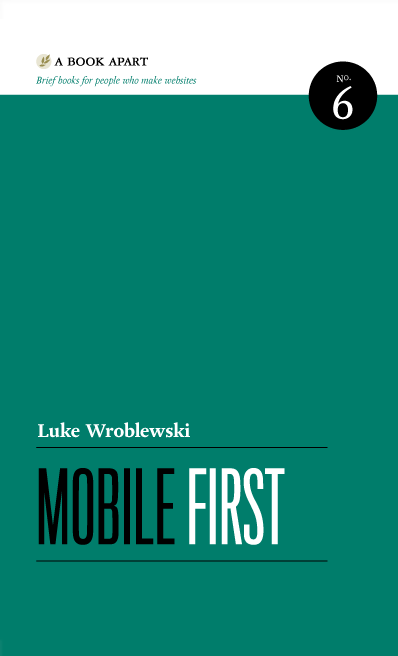
    A few weeks ago I finished this book. The book was written in 2011 by Luke Wroblewski who is an influential designer (if you don’t believe me check his twitter account with 150K followers) and although by technology standards it should be outdated but I found it quite relevant.

    The first chapter talks about why readers should care about mobile. 5 years after its publication I don’t think anyone need more data and proof on why mobile is important. In Chapter 2 he talks about mobile limitation and why it’s important to design with these limitations in mind. For example, it is true that despite bigger screens, cheaper data plans and longer battery life, people still find themselves in situations when they find their networks unreliable, their battery life fledgling and their screen too small compared to standard monitors. All of these limitations force product designers to focus on what customers need and this is actually a good thing:

    “When you consider the amount of useless navigation, content fluff, and irrelevant promotions that litter a typical web experience, you realize why the mobile diet can be good for both businesses and customers. Once people use the mobile version, it’s not uncommon for them to pine for the desktop version to be that simple.”

    Another factor to keep in mind is web performance. According to eMarketer, more people are relying on their mobile devices for digital access. This year in US alone, nearly one in 10 users exclusively go online through mobile and that number will continue to rise through the forecast period. And people dislike nothing more other than slow pages to load so anything can be done to increase performance on mobile should be done. At the highest level this means sending less stuff and using available browser and server technologies to speed up page load.

    He then briefly compares the native app vs mobile web and explain where each one is appropriate to use. This debate has been around for a long time but I find recommending one approach against another pointless. Because the answer is both!!Based on Forrester survey, majority of mobile users use mobile web sites for browsing and searching but they spent most of their times on native apps! So how can we explain this paradox?

    It turns out mobile web works better for consistency of experience across devices and for building a wide audience, but  mobile apps shine in creating a rich and engaging experience by leveraging more device specific capabilities like location and sensor data. Look at this excellent article to get even a better picture on why apps and the Web are both here to stay.

    I learned that mobile usage generally consists of a the following interaction types. These behaviors often determine how your mobile experience can be structured and organized to meet people’s needs:
    •    Lookup/Find: I need an answer to something now—frequently related to my current location in the world.
    •    Explore/Play: I have some time to kill and just want a few idle time distractions.
    •    Check In/Status: Something important to me keeps changing or updating and I want to stay on top of it.
    •    Edit/Create: I need to get something done now that can’t wait

    I also learned about Natural User Interface and some key concepts about organizing and navigating contents on mobile screens and areas suitable for placing common action buttons and what the best place to put ‘delete’ button so user doesn’t mistakenly hit it.

    Some of the concepts covered in the book like responsive design and touch gestures are now commonplace practices and screenshots of websites like flickr, yahoo and basecamp are out of date but none of really matter, I really enjoyed this book 🙂

  • Messaging Apps are coming

    Despite the fact that typing on mobile phone is cumbersome, messaging has been around for many years and in fact messaging is going through a surge of innovation. How come?

    There are plenty of reasons on why messaging is still in use.  The most important one is its asynchronous nature: unlike phone calls and video chats parties don’t need to be available at the same time yet conversation flows along at a decent pace. Another reason is (because typing in mobile is hard) people forgo the formalities and jump right into the main points with in a informal way and no one is surprised or offended about it. And last but not least now that our phones are with us all the time so is messaging. Through time messaging has become much more expressive.  It has evolved from sending and receiving SMS only to rich messages with pictures, stickers, videos and audio files. We can now express ourselves with more nuances in short bursts and binges through chats.

    In fact recently I’ve come across many blog posts and news article which makes me certain that messaging apps are the next big channel in reaching out to customers in a direct, casual way to start a conversation and provide services within the conversation itself.

    Products like Google Now and Siri has primed us to become more comfortable receiving help from non-human (Artificial Intelligence algorithms, bots etc). There are now many next generation messaging apps blurring the line between AI and actual human by taking on the role of  a personal coach or as a virtual assistant who get tasks done.

    Apps like Lark and Vida act as your personal health coach where you report back on what you ate, your work-out routine and other thing and your coach advise you how to stay on track to achieve your weight-loss/health goal. On the other category, Native works as your virtual travel agent who finds the best the itinerary and purchases it for you. There is Magic taking on a role of a task runner getting you errands from mundane (grocery shopping, food) to exotic (medicinal marijuna! according to this article). All you need to do is to start a conversation and ask for things/services. And there are many more.

    Finally there are weird apps like Invisible Girlfriend and Invisible Boyfriend where you fabricate an imaginary girlfriend/boyfriend in case you’re tired of being judged for being single!! It certainly wouldn’t be my way of tackling the problem but it sure is an interesting service!

    All above apps exists in addition to staggering number of messaging apps such as Facebook Messanger, WhatsApp, Line, Kik, Snapchat, Hangout etc that are all competing to capture users conversations with friends and family within their framework. All of this means one thing to me: Consolidation.

    It just makes sense to have a few messaging apps where not only you can have a rich conversation with your friends and family but also you can use them as your virtual assistant to get things done. This phenomena has happened in china where WeChat is the messaging app for millions not only to chat with each other but to interact with business to order food, arrange lifts or send and receive money.

    The biggest contender for consolidation is Messenger app (by Facebook) with well over 700+ million users and growing. This article explained the reasons on why Facebook account is no longer required for accessing Messenger. Essentially, Facebook realized not everyone wants a social network or News Feed, but everybody wants chats. Messenger is getting a boost from new features  such as send and receive money to friends, search and add GIF to keep users within Messenger and off of other competitors. And I wont be surprised if it builds or buys any assistant-as-App type of services within Messenger.

    For me part of the appeal of SMS was its access regardless of your phone, career or apps you have on the phone, the fact that it didn’t belong to anyone. I really am not comfortable to have Facebook Messenger app as my go-to-app (their past history with Privacy and Term of Use is not exactly stellar, you know?). It would be ideal if we could have a choice of on messaging apps but somehow all updates show up in a central place like notifications bars on the phone and we have access to chat history regardless of the app. One can only wish but until then I think we’re heading toward a burst of messaging apps and their eventual consolidations.

    PS: The inspiration for this post came from a recent blog posts on Nir and Far blog which got me introduced to “Assistant-as-App” phenomena as well as posts from Intercom on future of messaging and finally multiple interesting news on TechCrunch and Wired.

  • Mobile Security – a round up

    Every month I attend “Mobile Learning Lab” event. As the name suggests every event delves into one aspect of mobile (and recently wearables and Internet of Things) technology. This time the topic was on Mobile Security and I learned a few interesting things through expert panel speakers.

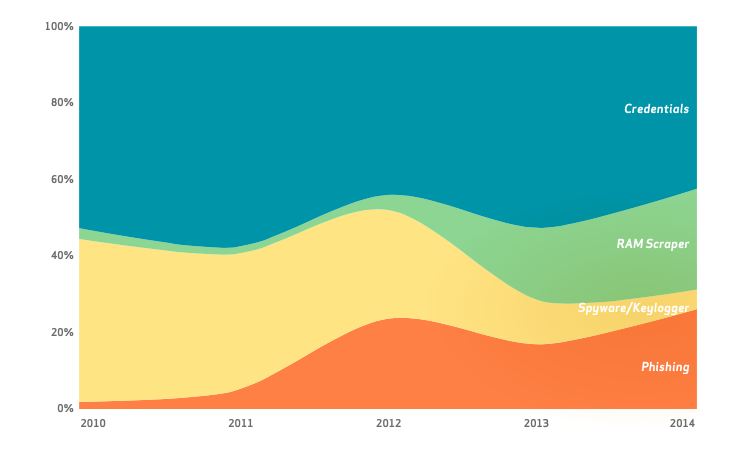
    First, I learned that Verizon publishes an annual report on data breach. This report which is written wittily and is easy to read (thank goodness for that) gives you a clear picture on main security breaches across different industries and platforms (desktop, mobile, Internet of Things). The following graph shows the breach trends over the past 5 years and for me it was one of the most interesting graphs through out the report. As you see RAM scraping and Phishing are major and growing problems:

    Significant threat actions over time by percent
    Verizon report, data breach trends

    RAM scraping is the type of malware that mostly targets credit card numbers at point-of-sales (POS) systems during milliseconds that it’s stored unencrypted in the back-end server’s memory for processing the transaction. RAM scraping has been identified as the primary reason of of high-profile retail data breaches such as Target and Home Depot. While email has become an essential part of our day-to-day work activities, Phishing has also become one of the easiest ways for criminals to load malware to a computers and spread it around.
    RAM scraping is the type of malware that mostly targets credit card numbers at point-of-sales (POS) systems during milliseconds that it’s stored unencrypted in the back-end server’s memory for processing the transaction. RAM scraping has been identified as the primary reason of of high-profile retail data breaches such as Target and Home Depot.

    Often an attack takes advantage of multiple techniques to target a primary victim and use it to further the real attack on its final company. Case in point, Target breach started with a hacked vendor — a heating and air conditioning company that was relieved of remote-access credentials after someone inside the company opened a virus-laden email attachment. Few days later, Target announced that attackers had stolen more than 70 million customer email addresses. The report shows nearly 70% of the attacks takes place on companies to use their compromised servers in denial-of- service (DoS) attacks, host malware, or be repurposed for a phishing site in order to attack another company. How awful!

    Mobile security (Android vs Apple)

    One of interesting part of the report and the subsequent panel discussion was the lack of serious threats on mobile phones. Above graph showed the main trends in threats and attacks on Android or iOS ain’t one of them. A closer look at all these attacks showed that Android phones have been more targeted than iPhones but most of attacks are short lived (less than a month until they fade away). One reason for lack of threats is the huge diversity among consumers’ hardware as well as different running version of OS on hand held items. Penetrating these many different phones and systems where no real financial gain opportunity is available (and there are so many easier ways to do so) has made hackers wary of targeting phones.

    However this doesn’t mean mobile is going to be a safe haven in the future. There is a good chance that enterprise mobile devices will be a good first target. Mostly because targeting one specific device model and OS will yield access to large population who’re using same or similar devices. Another area is older and more vulnerable protocols and technologies that have not been properly patched up. For example many companies are still using older (and often free) bluetooth technology that is very easy to penetrate. In fact Verizon report mentioned that 99.9% of vulnerability exploits happen more than a year after the vulnerability was disclosed!

    In the end involving security/IT team into the product development process early on as well as informing and educating mobile users on how to use their phones safely will be the most effective in preventing further attacks.