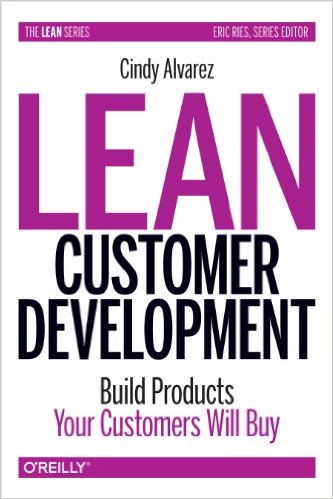
I’ve mentioned in my Resource page that I’m reading Lean Customer Development by Cindy Alvarez. It took me a while to finish it but I’m happy I did. In Product Management blogosphere and community you constantly hear about the importance of getting out of building, listening to customers, thinking about ideas in an “outside-in” fashion (where focus is on creating products/solution based on customer as oppose to “inside-out” way of creating product solutions from within the company) and having voice of customers understood during software lifecycle development.
Rightly so, many people think the single most important responsibility of a good product manager is to bring insights about customer’s needs and wants to the company and be able to get the development group to act upon them. I agree with all these but up to now I’ve had a hard time connecting directly with customers. I found it intimidating to reach out to our existing customers and potential prospects. What am I going to ask them? what if I send the wrong impression? how should I conduct an interview and finally how to interpret my answers and share it with other team members? This book not only laid out the foundation of how to approach the customer development but also provided me with a step-by-step practical list of how to get started! How fantastic!
Here are what I learned and some feedbacks I have on this book:
Customer development is meant be done parallel to product development. It is about systematically testing your hypothesis (guesses) around existing problems and potential solutions by asking customers to validate them. As a result you will learn what customers really want, and what are the key solutions they’re willing to pay for them. To me it’s obvious why customer development is important because if you don’t know what customers really want, you end up building something that no one wants to buy/use. I have seen this over and over and it still amazes me how often companies invest in resources and time to build a product only to sunset it after a few months. As a product manager having solid experience on talking with customers and brining their insights to the company is one of the key skill sets.
The process like many other scientific experiments are two fold. First you need to set up experiments by identifying assumptions and writing problem hypothesis then you go about validating (or invalidating) them. In order to do so you need to find “target customers”, plan the interview, ask questions, make observations and take notes. This book goes over each of these topics in great detail.
Cindy explains how to overcome fear of rejection of people not wanting to talk and offers tips on how to get introduced to new people through your direct connections and/or social media (LinkedIn, and Quora). It covers administrative stuff such as scheduling, no-shows and all those little details that make or break the whole process like making sure email copy is concise enough to be able to read and reply back within seconds over a mobile phone. But the most important part is what questions to ask and what not to asks. I learned that the main objective is to get customers talking and provide answers specific to their situation to learn as much as possible. Questions like “Tell me about how you do _________ today….” or “Do you use any [tools/products/apps/tricks] to help you get ________ done?” are best because they’re open ended and rely on past experience. Yes/No questions and questions that imply an answer within them (leading questions) are not as helpful.
The book covers other aspects of customer development including tips on note taking, validating/invalidating hypothesis and sharing your discoveries with the team. Overall I enjoyed the book very much and I’ll keep going back to it for more how-to on my next round of talking to customers. The only thing I didn’t understand was the emphasis to call this book “Lean”. Sure, I understand that by invalidating hypothesis around what customer’s going to use, we’re saving a lot of time and development not building features no one uses (eliminating waste–> Lean) but I see customer development as an integral part of product manager job in both startup and big corporations alike and therefore maybe I would just call it “A manual for Customer Development” 🙂
Cindy also writes in her blog in the same approachable easy way about customer development and other areas of product management as well. Check her out!

