Category: Jobs-To-Be-Done

  • What I learned professionally in 2019

    In 2019 I read 17 books which may not sound like much but for me it’s the highest number of books I’ve read in years (here is my “completed” books in Goodreads). In addition to an earlier post about my favorite 2019 books here are some other ones that I strongly recommend you to read:

    Better

    Better” simply was one of the best books I read and Atul Gawande is now my favourite writer. Even though Better mostly talks about what it takes to be a better doctor I found the advice universal to all professions and extremely useful. It talked about becoming better by applying diligence, incorporating ingenuity to understand root problems and do right by people while weaving fascinating medical and public health stories from around the world to deliver the points.

    Asshole survival guide

    “The Asshole Survival Guide” offers strategies in dealing with, avoiding and even fighting general assholery in your life. In addition to highlighting what makes a person an asshole, the author also sheds light on blame and call-out culture, reminding us that personal responsibility and empathy is key even when dealing with assholes. I must confess that I found the book depressing but useful.

    Obviously Awesome

    “Obviously Awesome” is one of the best marketing and strategy books I’ve read this year which provides practical and useful ways to look at a business and the efforts it takes to position a product or service. The advice is sound for both startups and mature products and it provides a systematic way to apply Jobs To Be Done for your marketing efforts.

    Committing to Be a Better Communicator

    This year my boss gave me critical feedback that despite my best effort when presenting to upper management or stakeholder in general, my ideas seems complicated and people leave the meeting feeling confused. This was an important discovery for me (as in my head I was very clear on what I want to convey) so I invested to fix this.

    I read some excellent books on public speaking and started going to Toastmasters to practice my public speaking because no matter how much you read about something you only get better by applying it in practice! Even though I’m far from perfect I learned about main elements of a talk and gained valuable insight on what makes a presentation great. I’ll definitely will continue this path.

    Letting Go of rigidness of Agile

    At the peak of this year I worked on six projects (2 of them major ones) with four remote teams. Since all teams worked in agile I attended a lot of ceremonies from daily stand ups to end-of-sprint retrospective. I understand the ratio of 1 PM to 16 engineers is out of whack but frankly I spent all this time hoping to help my team but not only many of these meetings weren’t good use of my time but they felt draining. In many of them it seemed the core Agile principles have faded; instead people were focused on the useless nuances like endless discussion about story points per user story (everything tended to be given 3, 5 or 8 points to show that its small but not too small), or doing retrospective rituals (what went well, what went not so well) with no tangible improvement in the way the worked or their output.

    As controversial as this may sound I don’t care about these agile ceremonies anymore. Don’t get me wrong, I still love the idea of iterating and delivering thin layers of end-to-end functionality as oppose to give me all the requirement upfront and I wait and see the result but for me an ideal way of working is an engaged team who understands product vision, asks questions when things are not clear, collaborates and challenges PM on the solution put fort, constantly shows the work completed and releases it to production regardless of how they do it.

    and with that looking forward to all the learning that 2020 will bring!

  • How can we come up with new product ideas?

    How can we come up with new product ideas?

    I have previously written about Jobs To Be Done but the topic is still fascinating to me because I think this is a key tool to do customer discovery and ultimately drive product strategy. There are also so many overlaps between JTBD, design thinking and the concepts that were covered in Badass book that convinces me there is real value in understanding and pursuing them.

    In continuation with my previous research this time I managed to read the latest Clayton Christensen book along with one practical guide intercom published a while back on the topic. To refresh your mind here is what JTBD:

    A job basically is another way of defining underlying user’s need without focusing too much on user’s attributes. What I mean by user’s attributes are characteristics that define a user, like gender, age, occupation etc. The core theory of Jobs to be Done stems from the fact that customers pull a product or service into their lives when they are trying to solve a problem regardless of who they are. Problems in our lives always exist and we as customers pull products or services available to us into our lives as a way to satisfy those problem. The first product/services that address the job is not very good however they are competing with nothing (or as Mr. Christensen puts it they are competing with non-consumption) and they are making something happen when it was not possible before so we hire them. Over time because we are looking to make progress in solving our problem when we find a better, faster and cheaper solution we fire the old solution and hire the better solution.

    Let me explain these concept with an example: talking to your loved ones when you are far away is a universal problem. This problem fits a description of a job because regardless of people’s age, gender and/or location the need to communicate always exists. I remember when my aunt left Iran in 1985 to get her bachelor’s degree oversees, calling her was so expensive that my grand parents could only afford to talk for 10 minutes a week and those phone calls would cost a fortune at the end of the month. Few years later, when prepaid international phone cards came to market, national telecom company was quickly fired and prepaid phone cards were hired immediately instead. This solution was much more cost effective so now my grand parents could talk hours instead of minutes per week for the same cost. Fast forward to now where with ubiquitous availability of mobile phones and Voice over IP technology we now hire Skype and What’s app to talk however long we want for free.

    What is interesting is that JTBD helps us to view solutions for hire holistically by not just focusing on direct competitors in one market but to understand that the solution for hire can come from indirect competition. A few years ago if you asked business folks at telecom giants like Verizon in US or Rogers in Canada about their competitors I bet names like AT&T or Bell (which are other giant telecom) will pop up. They would never considered a rinky-dink company founded in Estonia that provided computer-to-computer calls to be a threat. Skype however was quickly hired by international students who were technology-savvy but poor to call home. They would tolerate bad voice quality and dropped calls as long as the talk to friends and family back home. Within 2 years Skype penetrated the market so fast that was bought for a record $2.5 billion in 2005. Fast forward to now where many of us don’t have a landline anymore let alone making an oversees call from it!!

  • Build Your Product Strategy using this Blueprint

    Build Your Product Strategy using this Blueprint

    If you want to switch from waterfall and are new to agile there are many resources and blueprints available to get started and to tell you what to do next. There are courses to take and books to read and experienced people to learn from on how to build, test and ship software in iterative and continuous way.

    But what about all the activities that we do to decide what to build? Is there a blueprint we can follow on what to do next so we can make informed decisions on what to build? If you are like me, you have come across all different methodologies like Design Sprint, Jobs To Be Done, Lean Startup, Customer Development and Design Thinking over time and the question is, how do we know if these tools are helping us, and how do we know what to use when? How do I decide which ones are right for my team?

    I came across a (long) blog post followed by a video of Teresa Torres that answered all the above questions. Take a look at the video:

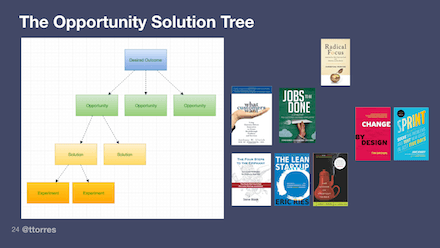
    In Summary, her idea is to build a decision tree (she calls it Opportunity Solution Tree) to make sure that we have thought about different aspect of what to build. The root starts with finding what the clear desired outcome is. We need to define a qualitative objective, combined with quantitative key results, so that we can measure if we are getting closer to our desired outcome. Next comes as identifying opportunities (which is the fancier word for problems and pain points you want to build solution for) and only after these two levels are clearly defined you can compare and categorize solutions and ideas to see if they tie back to the making better outcome.

    The great thing about Opportunity Solution Tree is that it gives you the blueprint I was craving earlier. This means there is a systematic way to use different methodologies at each levels to identify the problems/opportunities, solutions and validate if the proposed solutions will work. This is helpful to me because it it helps me to identify which method to pick. Take a look at this diagram here. In a glance I can now see Jobs-To-Be-Done more focuses at defining the problem but tools like design sprint talks more how to build the solution.

    One final note is like Agile concepts, I think this mapping concept is easy to understand but hard to implement. I am trying this at work right now I will let you know how things go!

  • What job are customers hiring your product for?

    If you noticed I used the framework of Jobs T0 Be Done in my previous post when I tried to compare multiple email marketing solutions with each other. Asking “What job are you hiring this product for?” is an odd question and it took me some time to wrap my head around thinking about a product like it’s a person or service I can hire. This is an essence of Jobs To Be Done framework but when I talk to people not many know about it. So I researched multiple articles and listened to a couple of podcasts to learn more about it. Without further ado here is what I’ve learned:

    What is Jobs To Be Done and where does it come from?

    If you search Jobs-to-be-Done, you’ll find this video from Clay Christensen, a famous Harvard Business School professor who came up with the framework. (He’s also the guy who came up with the idea of Disruptive Innovation in his seminal book the The Innovator’s Dilemma). Anyway, Clay speaks about a product development issue in a fast food chain where they wanted to sell more milkshakes.

    Their initial approach was to talk to buyers and make changes to milkshake based on this customer analysis. They asked buyers if they like their milkshakes be healthier or more sugary, thicker or thinner etc. This failed. They sold no extra milkshakes, as there was no meaningful insight to be found in analyzing the users themselves. So he suggested that they focus on the job that customers hire a milkshake to do.

    It certainly sounds weird (no-one thinks of “hiring a milkshake”) but switching to that perspective offered new insights. After talking to buyers in this new format, it turns out more than half of the milkshakes are hired to do the job of providing sustenance and entertainment for a long commute. In this regard milkshakes were competing with bagels, bananas, and energy bars. Milkshakes had advantages over energy bars and bananas, as they’re tidier and easier to consume in a car. They beats bagels because bagels are too dry and leave you thirsty in your car. They beats coffee because they are more filling and less likely to don’t leave you desperate for a bathroom in the midst of a 40 minute drive. Once the chain realized this, they were able to make changes that made milkshakes the best tool for the job.

    When using Personas are helpful

    Similar to the restaurant chain example above product designer, product manager and UX/UI  team try to talk to users to understand what they’re looking to get out of  software. They come up with user personas and user roles.  Once personas are defined, then they try to design and define a system in a way to deliver users’ needs and wants as a series of user stories.

    Personas work well when the user base is broken down into different types of users with different needs. For example, if trying to create a market place it is helpful to define distinctive types of personas based on buyers and sellers roles. These personas are definitely helpful to define what your system must fulfill for each of them.

    When Personas are not useful, focus on the Job instead

    However for many products (and I’m thinking many B2C type of software) the customers come in all shapes and sizes, from all countries, all backgrounds, all salaries, all levels of computer skills. In these circumstances defining persona is not as useful as there is no way to group your users into meaningful roles to define a system for.

    Another time when focusing on the job is more helpful is when a situation dictates the solution as oppose to your user’s characteristics or attribute.

    For example, after a long day of work and with an empty fridge, Alan who is single and in his early 30s is looking for a comfort food with minimal prep time and dish washing afterwards. That when he orders Pizza! However the same Alan on Friday night when he has a date  in order to impress his date, he’ll go to a fancy Italian restaurant.

    In both cases the situation and the problem context dictated the solution as oppose to Allan’s attributes of being ‘single’ or ‘in his 30s’.

    Jobs-To-Be-Done framework becomes very useful because the product is better defined by the job they do than the personas it serves. Now it’s best to get an intimate understanding of the job itself, what creates demand for it, and what ultimately what you’d hire to do the job.

    Another cool example that I’m going to borrow from Intercom blog is when you hire a photo app:

    When do you hire a web app?

    There are a few different jobs you might like to do once you’ve taken a photograph. Here’s six:

    1. Capture this moment privately for me and her, so we can (hopefully) look back on it fondly in years to come
    2. Embarrass my friend in front of her friends, cause she’ll regret this in the morning.
    3. Get this file backed up online, so I can point others to it.
    4. Get a copy of this photo to my grandmother who doesn’t use computers.
    5. Make this look cool and interesting. Like me. And then share it.
    6. Get this edited and into my portfolio so that people consider hiring me for future engagements.

    In this case the products you could hire are Facebook, Flickr, iPhoto, Instagram, maybe 500px. When you think about how many of these apps you use, you realize that the job is the distinction here, not you. You haven’t changed.

    Jobs-To-Be-Done Interview and Job Stories

    To understand “the job” you have to interview users to understand their struggles, alternative solutions to the job and finally what made them purchase your product to solve the job. (There is a Jobs-To-Be-Done interview course  teaching interview techniques). As a product manager you act as a detector! your mission is to find out:

    • what situation the users were in when they encountered the job?
    • what caused them to take the action ?
    • What steps they took to come to the conclusion to hire your products?
    • What are other solutions (software or not) that are competing with the solution you offer?

    For the reasons outlined above, Alan Klement goes as far as suggestion to use Job Stories instead of User Stories.

    There is so much for to learn about this framework and I find it fascinating. One final thing I learned is that there are no new jobs! Jobs don’t change but the solution that’s satisfy the job changes over time. What do you think?

    Resources

    Finally if you are interested to learn more about this let me know, I know a great knowledgeable person  in GTA and we have a meetup to chat JTBD if there is enough interests 🙂